

Hot Water Heater Repair: Top 5 Speedy Fixes
Why Hot Water Heater Repair Matters to Riverside Homeowners
Hot water heater repair becomes urgent when you’re left with a cold shower or find a puddle around your tank. Here are the key things to know:
Common Water Heater Problems & Solutions:
- No Hot Water – Check the pilot light (gas) or circuit breaker (electric); may need a heating element or thermostat replacement.
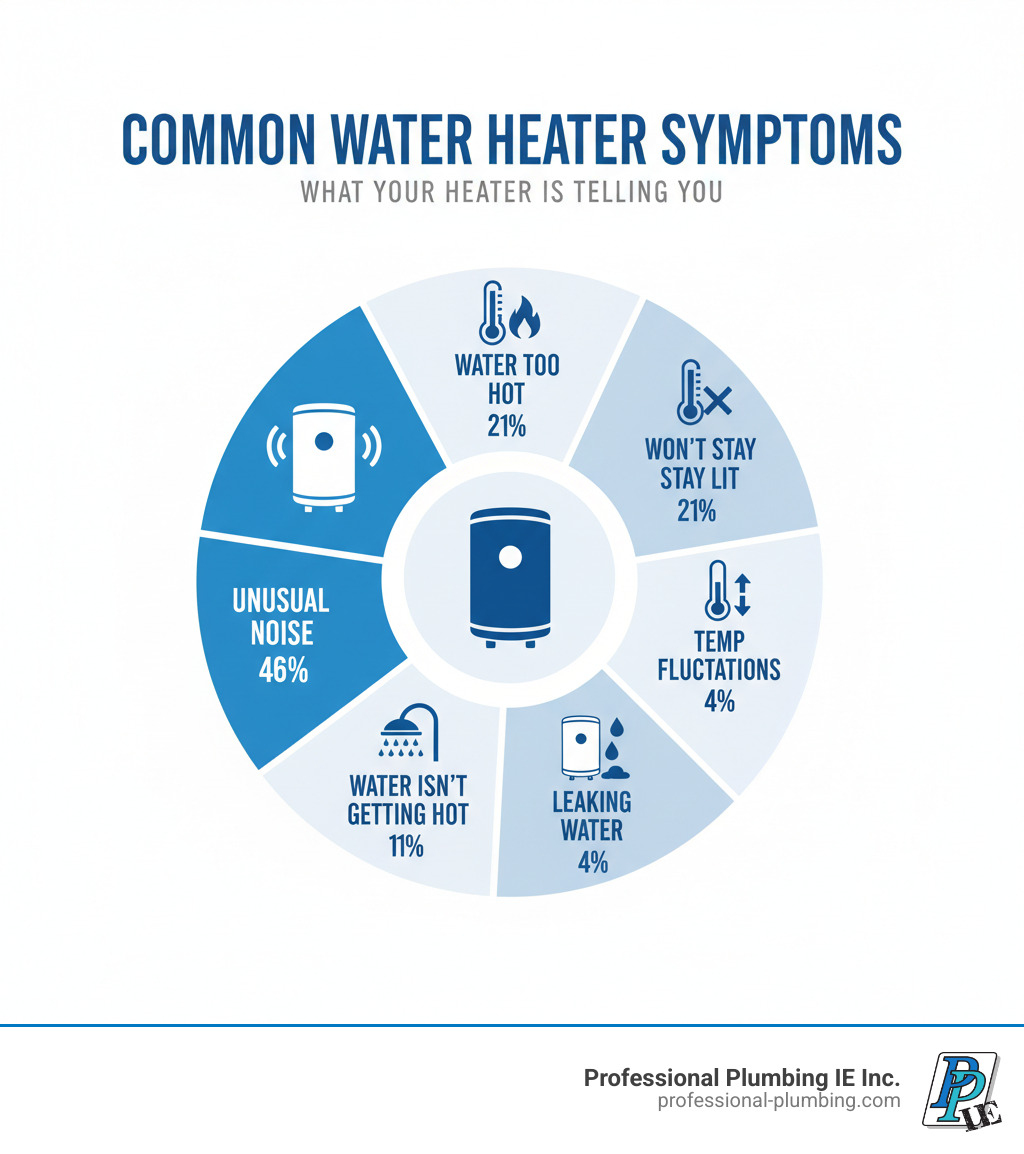
- Unusual Noises (46% of issues) – Usually caused by sediment buildup; requires tank flushing or heating element repair.
- Water Too Hot or Won’t Stay Lit (21% each) – Can be a faulty thermostat or gas valve; needs professional adjustment or replacement.
- Leaking Water (4% of issues) – Inspect the drain valve, T&P relief valve, or for tank corrosion; may require immediate replacement.
- Rusty or Smelly Water – Indicates anode rod failure or bacteria; needs a professional inspection.
According to industry data, a conventional water heater lasts 8-12 years, while tankless models can last up to 20 years with proper maintenance. If your unit is over 10 years old and needs a repair costing more than half the replacement price, replacement is usually the smarter choice.
A broken water heater disrupts your entire household. Fortunately, many common issues are fixable, and knowing when to call a professional can save you time and money. Service calls typically start at $129, with basic repairs ranging from $150-$500. Major issues like tank leaks often mean it’s time for a replacement, which runs $650-$1,250 for conventional units or $850-$1,750 for tankless systems.
Catching problems early is key. A strange pop or temperature change could be a warning sign of a bigger issue ahead.
Is Your Water Heater Crying for Help? Telltale Signs
Your water heater rarely fails without warning. Catching early signals can mean the difference between a simple hot water heater repair and a flooded garage. The most obvious signs are no hot water or hot water that runs out too quickly. The culprit could be a tripped limit switch, a burned-out heating element, a pilot light that won’t stay lit, or a thick layer of sediment in the tank.
Watch for other indicators that your heater needs professional attention. We’ve covered these in our articles on Signs that your water heater needs repair Pt. 1 and Signs that your water heater needs repair Pt. 2.
Diagnosing Unusual Noises
Unusual noises like popping or rumbling are a sign of trouble. In fact, 46% of water heater problems start with strange sounds. Most noises come from sediment buildup. Minerals settle and harden at the bottom of the tank. When the burner or element heats this layer, trapped water pops and crackles, causing popping, rumbling, or sizzling sounds.
A whining noise often points to a struggling heating element. Ignoring these sounds leads to higher energy bills and a shorter unit lifespan. For more help, check out our Hot water heater basics and troubleshooting guide.
Spotting Leaks and Water Damage
Never ignore a leak. While only 4% of complaints involve leaks, they are among the most serious issues. A small drip can become a flood, causing thousands in damage. If you see puddles around the base, investigate immediately. The leak could come from the temperature and pressure relief valve (T&P valve), the drain valve, or a loose pipe fitting connection.
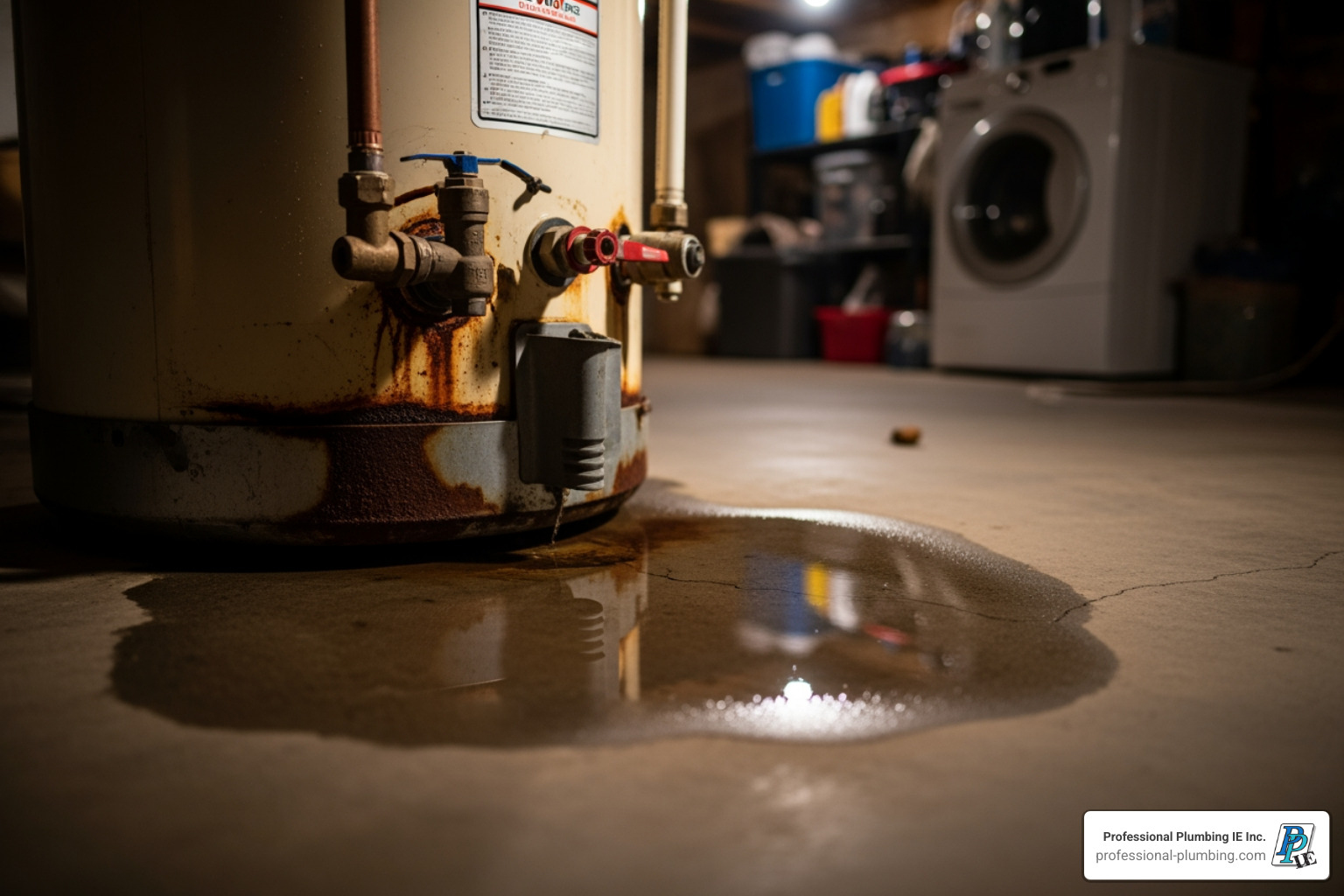
However, if the tank itself is leaking due to tank corrosion, it cannot be fixed and must be replaced.
Water Temperature and Quality Problems
Water that is too hot, not hot enough, or has a strange look or smell is a clear sign of a problem.
- Lukewarm water (11% of issues) often means a failed heating element, faulty thermostat, or pilot light issue.
- Scalding hot water (21% of issues) is dangerous and usually points to a thermostat set too high or one that has failed.
- Fluctuating temperatures (4% of users) often indicate a failing thermostat or heating element.
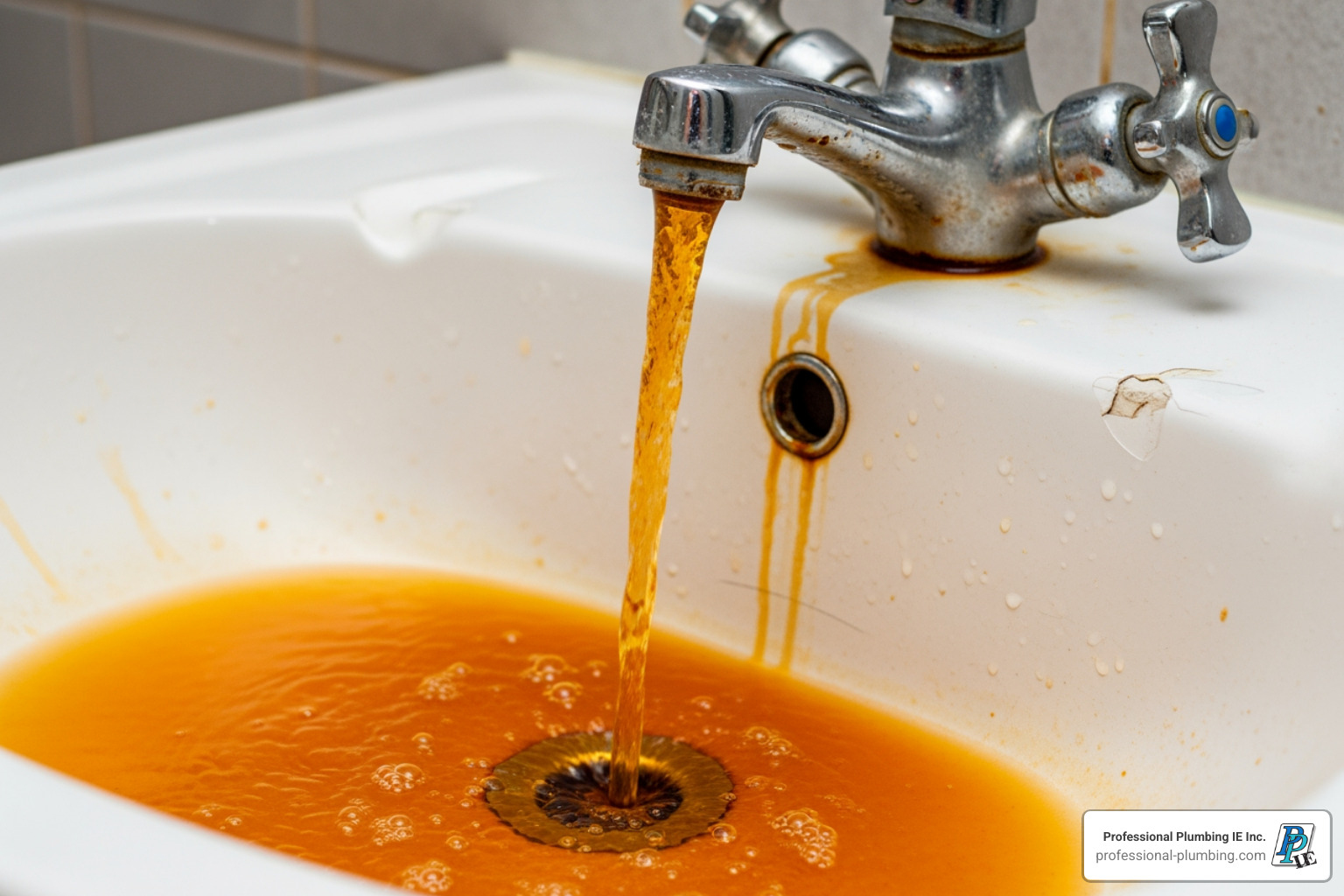
Water quality issues tell their own story. Rusty or discolored water suggests a failed anode rod, which causes the tank to rust from the inside. Foul odors, like rotten eggs, indicate bacteria in the tank, a problem often linked to a failing anode rod. These are signs of declining water heater health. The University of Georgia Extension’s guide on odors in your water offers more helpful insights.
Troubleshooting Common Water Heater Failures
When your water heater fails, it can be overwhelming. However, most failures have clear causes. Understanding the problem is the first step to a quick, correct hot water heater repair.
Common culprits differ for gas and electric models. For gas models, a pilot light that is out or keeps shutting off (21% of issues) may be due to a faulty thermocouple, a gas valve issue, or a draft. Electric models often fail due to a tripped breaker, a burned-out heating element, or a faulty thermostat.
Sediment buildup affects both types. Minerals from hard water, common in Riverside, settle in the tank, forming an insulating layer that forces the heater to work harder and leads to component failure.
DIY vs. Professional Hot Water Heater Repair: What’s Safe?
While DIY repairs can be satisfying, with hot water heater repair, knowing when to call a professional is a matter of safety. Resetting a circuit breaker or relighting a pilot light (following instructions carefully) are safe DIY tasks. Beyond that, repairs get risky.
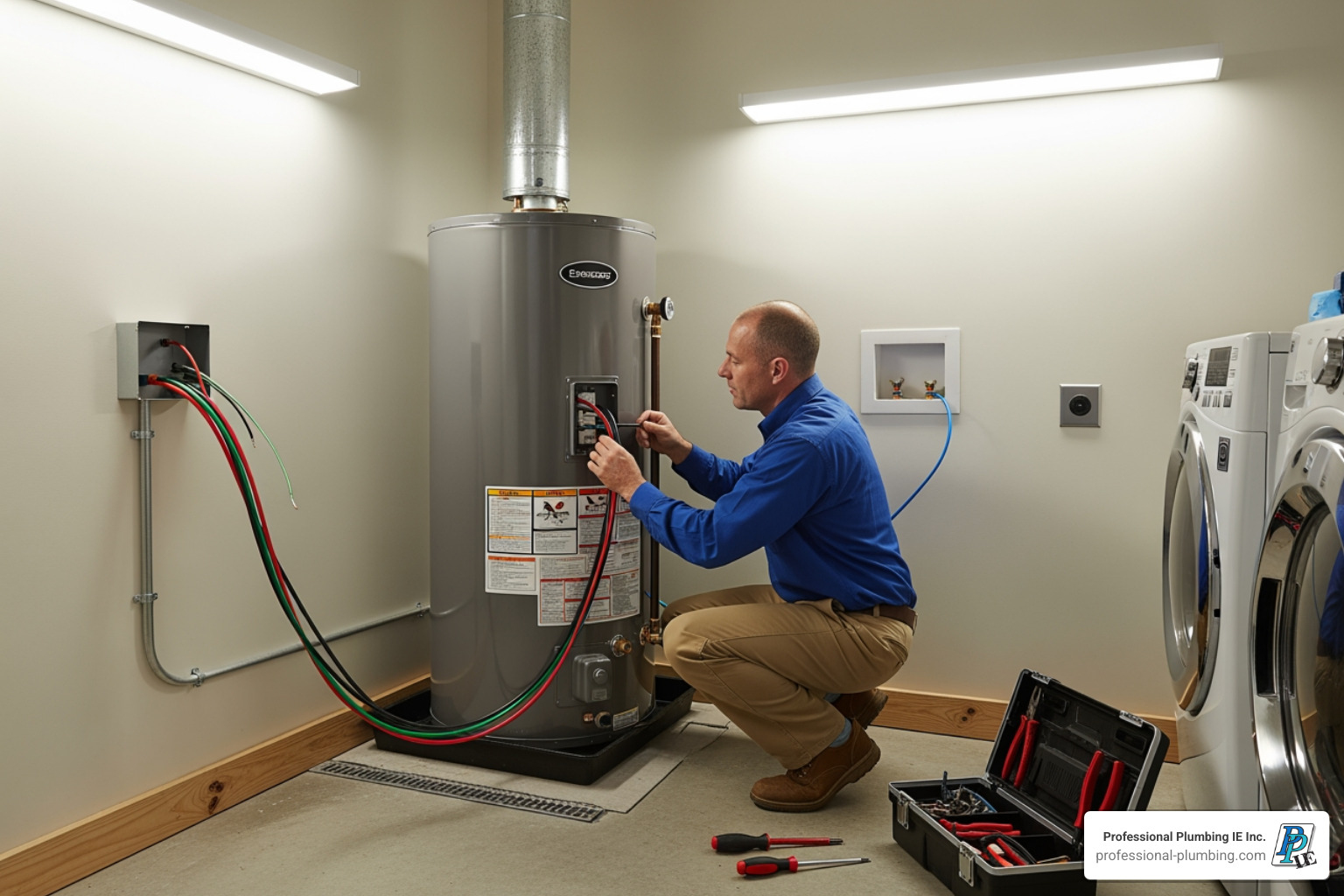
Always turn off the power at the breaker box for electric heaters or shut off the gas supply for gas units before attempting any work. Electric heaters have high voltage; replacing heating elements or thermostats is dangerous without electrical experience. Gas heaters pose risks of leaks, explosions, or carbon monoxide poisoning. Never tamper with gas lines. If you smell gas, leave your home immediately and call for help from a safe location.
Call a professional for any gas-related issues, tank leaks, persistent electrical problems, or any repair you’re not comfortable with. Our team at Professional Plumbing Inc. has handled these situations safely for nearly 40 years. For more guidance, visit our Hot water heater basics and troubleshooting section.
Addressing Sediment Buildup
In Riverside’s hard water, minerals settle at the bottom of your tank, forming sediment. This layer insulates the water from the heat source, forcing the unit to work harder. This leads to higher energy bills, lower efficiency, and rumbling sounds.
The solution is to flush the tank annually. This involves draining the tank to wash out mineral deposits. It’s also the perfect time to inspect the anode rod. The anode rod is a sacrificial component that corrodes to protect the tank lining. Replacing a heavily corroded rod can add years to your heater’s life. Neglecting it leads to tank corrosion and premature failure.
Fixing Leaks and Drips
Some water heater leaks are fixable, while others mean it’s time for a replacement.
The Temperature and Pressure (T&P) relief valve is a key safety device. If it drips, the tank’s pressure or temperature may be too high, or the valve is faulty. Constant discharge requires immediate professional attention.
Drain valve leaks are often less serious and may only require tightening or replacement. Pipe fitting connections can leak due to loose or worn fittings, which can usually be tightened or re-sealed.
However, if water leaks from the tank itself, it indicates internal corrosion. A corroded tank cannot be repaired and must be replaced. For help with leak repairs, check out our Project: Water Heating Project page.
Understanding Your System: A Guide to Water Heater Types
Understanding your water heater is key for effective hot water heater repair and long-term satisfaction. In Riverside, Corona, and Fountain Valley, we service two main types: traditional storage tank heaters and modern tankless models. Both are available in gas and electric versions, each with unique maintenance needs.
| Feature | Conventional Storage Tank Heater | Tankless (On-Demand) Water Heater |
|---|---|---|
| Lifespan | 8-12 years (average 11 years) | Up to 20 years (with proper maintenance) |
| Upfront Cost | Lower ($560-$2500 unit cost) | Higher ($850-$4500 unit cost) |
| Operating Cost | Higher (constantly heating water) | Lower (heats water only when needed) |
| Maintenance | Annual flushing for sediment, anode rod check | Annual descaling, filter cleaning |
| Hot Water | Limited by tank size | Endless (on-demand) |
| Space | Large, bulky tank | Compact, wall-mounted |
Conventional Storage Tank Heaters
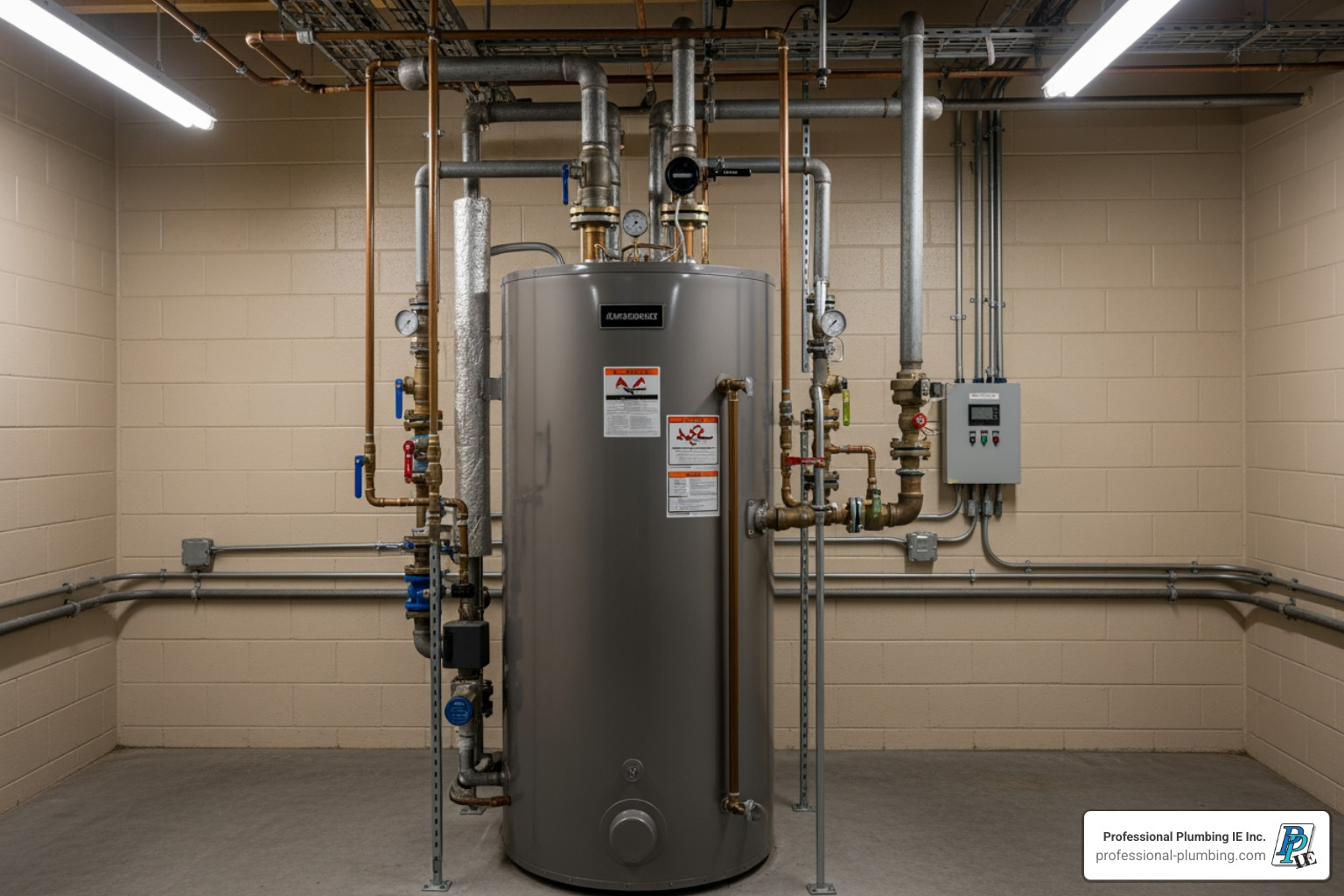
A conventional storage tank heater is the large cylindrical tank often found in a garage or utility closet. It stores and continuously heats 30 to 80 gallons of water. The average lifespan is eight to 12 years. Their biggest enemy is sediment buildup, which forces the unit to work harder, wastes energy, and causes popping or rumbling sounds.
The anode rod is a sacrificial component that corrodes to protect the tank. Checking and replacing it every few years can significantly extend the heater’s life. Common repairs include replacing heating elements (electric), thermocouples and pilot lights (gas), thermostats, and temperature and pressure relief valves. For detailed guidance on these repairs, check out our Project: Water Heating Project 2.
Tankless (On-Demand) Water Heaters
Tankless water heaters are a popular modern alternative. Instead of storing water, these compact units heat it instantly on demand. A well-maintained tankless system can last up to 20 years, nearly double the lifespan of a conventional tank.
Since they only heat water when needed, tankless heaters are far more energy-efficient, leading to lower utility bills. While the higher upfront cost is a factor, many homeowners find the long-term savings and endless hot water supply to be a worthy investment.
Tankless units require annual descaling to prevent mineral buildup in the heat exchanger, which is crucial in areas with hard water. This preventive maintenance ensures efficiency and longevity. If you’re curious about making the switch, we’ve written about the benefits of tankless water heaters and how they might fit your household’s needs.
The Big Decision: Hot Water Heater Repair vs. Replacement
Every homeowner eventually faces the decision: repair or replace an aging water heater. The right answer depends on the unit’s age, the type of repair needed, the frequency of past issues, and the potential long-term savings of a new model.
When is Replacement the Smarter Choice?
If your conventional unit is over 10-12 years old and needs a major repair, replacement is often the smarter financial choice. At this age, other components are likely to fail soon.
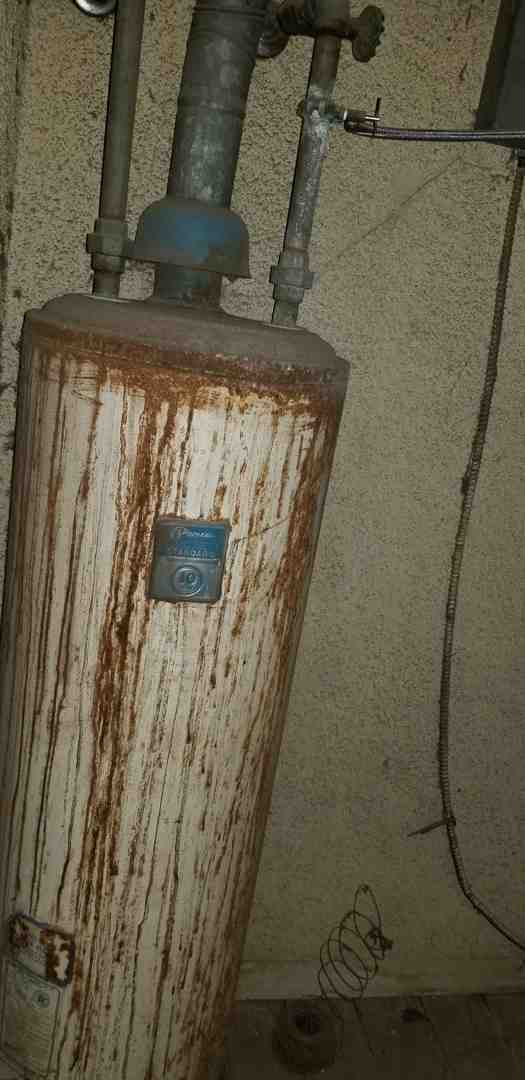
A leaking tank is a definitive sign that replacement is necessary. This indicates internal corrosion that cannot be repaired. Major corrosion or visible rust on the tank also signals that the unit’s integrity is compromised.
A good rule of thumb: if the repair cost is over 50% of the replacement cost, invest in a new unit. You’ll get a new warranty and improved efficiency. Upgrading for efficiency, especially to a tankless model, can also significantly lower utility bills.
Ready to explore your options? We specialize in Water heater replacement Riverside and the surrounding areas.
Estimating the Cost of Hot Water Heater Repair
Understanding potential repair costs helps in decision-making. Here are typical cost ranges for hot water heater repair in our service areas.
Our service call fee is $129 for the visit and diagnosis. From there, costs vary:
- Thermocouple replacement: $150-$300
- Heating element replacement: $200-$400 per element
- Thermostat replacement: $150-$350
- T&P valve replacement: $150-$300
- Drain valve replacement: $100-$250
These are estimates; we always provide transparent, upfront pricing before any work begins.
Replacement Costs and Upgrade Benefits
If replacement is the best option, it’s important to understand the costs and benefits. A conventional water heater replacement typically costs between $650 and $1,250 installed (unit cost: $560-$2,500; disposal: $150-$350). Tankless water heater replacement has a higher upfront cost, from $850 to $1,750 installed (unit cost: $850-$4,500; disposal: $125-$320).
A new water heater is an upgrade. Modern units offer significant long-term energy savings, especially Energy Star models. Tankless systems are highly efficient as they only heat water on demand. They also provide endless hot water and offer significant space savings by mounting on a wall. A new unit also provides peace of mind with a fresh warranty and reliable performance. Our team is ready to help you choose the right system for your home. Learn more about our Water heater replacement Riverside services.
Proactive Care: Simple Maintenance to Extend Your Heater’s Life
Regular maintenance can extend your water heater’s life and help you avoid expensive hot water heater repair calls. Most tasks are straightforward.
For a conventional tank, the most important task is to flush it annually to remove sediment. Turn off the power/gas, connect a hose to the drain valve, and drain until the water runs clear. This improves efficiency, quiets the unit, and extends its life.
Also, have a professional check your anode rod annually. This sacrificial rod protects your tank from rust and typically needs replacement every 3-5 years. It’s one of the best investments in your heater’s longevity.
Test your T&P valve (temperature and pressure relief valve) once or twice a year. Lift the lever; water should flow from the discharge pipe. If it doesn’t, or if it drips after, the valve needs replacement. This is a critical safety device.
Set the thermostat to 120°F. This is the ideal balance for safety, energy efficiency, and performance. Many factory settings are too high, so this adjustment can save money immediately.
Finally, insulate your hot water pipes, especially the first few feet from the heater. This inexpensive step reduces heat loss, saves energy, and delivers hot water faster.
While some tasks are DIY-friendly, complex jobs like replacing an anode rod are best left to professionals. Our team at Professional Plumbing Inc. has maintained water heaters in Riverside, Corona, and Orange County for nearly 40 years. We know how to keep your system running smoothly. For comprehensive maintenance services, visit our Service: Water Heater page, or explore more tips in our Category: Articles: Water Heating section.
Conclusion: Your Next Steps for Reliable Hot Water in Riverside
You now know how to recognize when your water heater needs help, from a rumbling noise to a puddle at its base. You’re equipped to understand the signs and take action.
The most important takeaway is to not ignore warning signs. A small issue today can become a major failure tomorrow. Early action saves money, prevents damage, and ensures your family’s comfort.
While basic troubleshooting is fine for homeowners, many hot water heater repair tasks carry risks like gas leaks or electrical hazards. When in doubt, calling a professional is the safe choice.
For nearly 40 years, Professional Plumbing Inc. has served families in Riverside, Corona, Orange County, and Fountain Valley. As a family-owned business, we pride ourselves on quality work. Our technicians explain your options clearly, helping you make the best decision for your home and budget.
Whether you need an emergency repair or preventive maintenance, we’re here to help. We guarantee professional, quality service at affordable rates.
Ready to get your hot water flowing again? Don’t spend another day dealing with cold showers or worrying about that mysterious leak. Get help from an emergency plumber in Riverside and let us restore comfort and peace of mind to your home.


Pingback: Emergency Plumbing Services Riverside: 5 Expert Tips
[…] hot water heater repair […]