
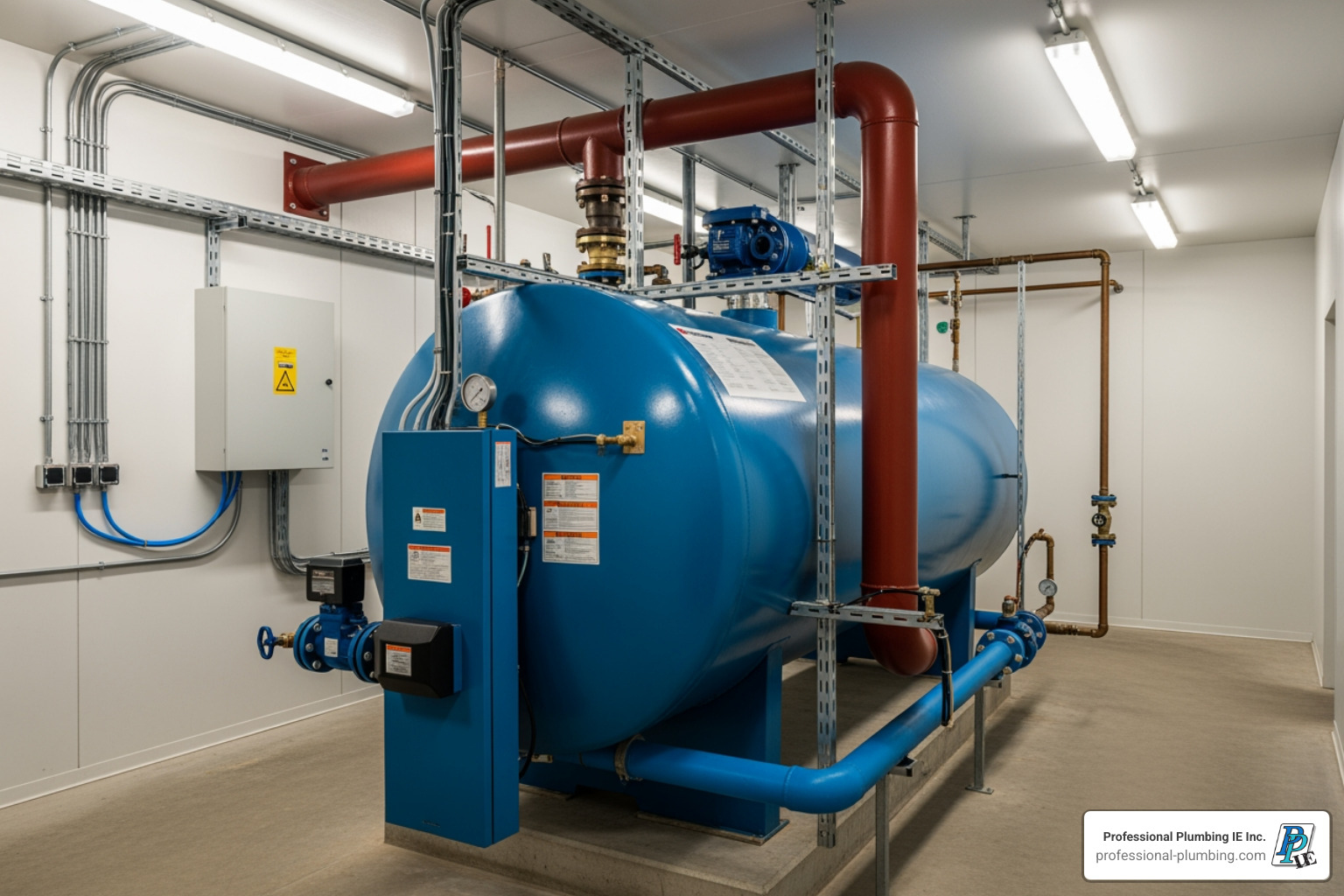
Commercial Hot Water Heater Replacement 2025: Flawless
Why Your Business Can’t Afford a Failing Water Heater
Commercial hot water heater replacement is a critical investment that keeps your business running smoothly and efficiently. Whether you operate a restaurant, hotel, multi-family property, or any facility that depends on consistent hot water, understanding when and how to replace your commercial water heater can save you from costly downtime and skyrocketing energy bills.
Quick Answer: When to Replace Your Commercial Water Heater
Replace your commercial water heater when you notice:
- Age: Your unit is 8-12 years old (even if it seems functional)
- Leaks: Pooling water around the base or connections
- Performance: Inconsistent temperatures or frequent hot water shortages
- Water Quality: Rusty, discolored, or foul-smelling hot water
- Costs: Rising energy bills or frequent repair calls
- Noises: Rumbling, popping, or banging sounds from the tank
The Business Impact
Hot water isn’t just a convenience—it’s essential for daily operations. Natural Resources Canada estimates that 5.7% of energy used in commercial settings comes from water heaters. The average restaurant alone uses about 2 gallons of hot water per meal served.
When your water heater fails, the consequences are immediate. Guests can’t shower. Kitchens can’t sanitize dishes. Operations grind to a halt.
The good news? Modern commercial water heaters are far more efficient than older models. ENERGY STAR certified units use 15% less energy than standard models, translating to real savings on your utility bills while providing more reliable hot water.
This guide walks you through everything you need to know about commercial hot water heater replacement—from recognizing warning signs to selecting the right unit and ensuring proper installation. We’ll help you make informed decisions that protect your business and your bottom line.
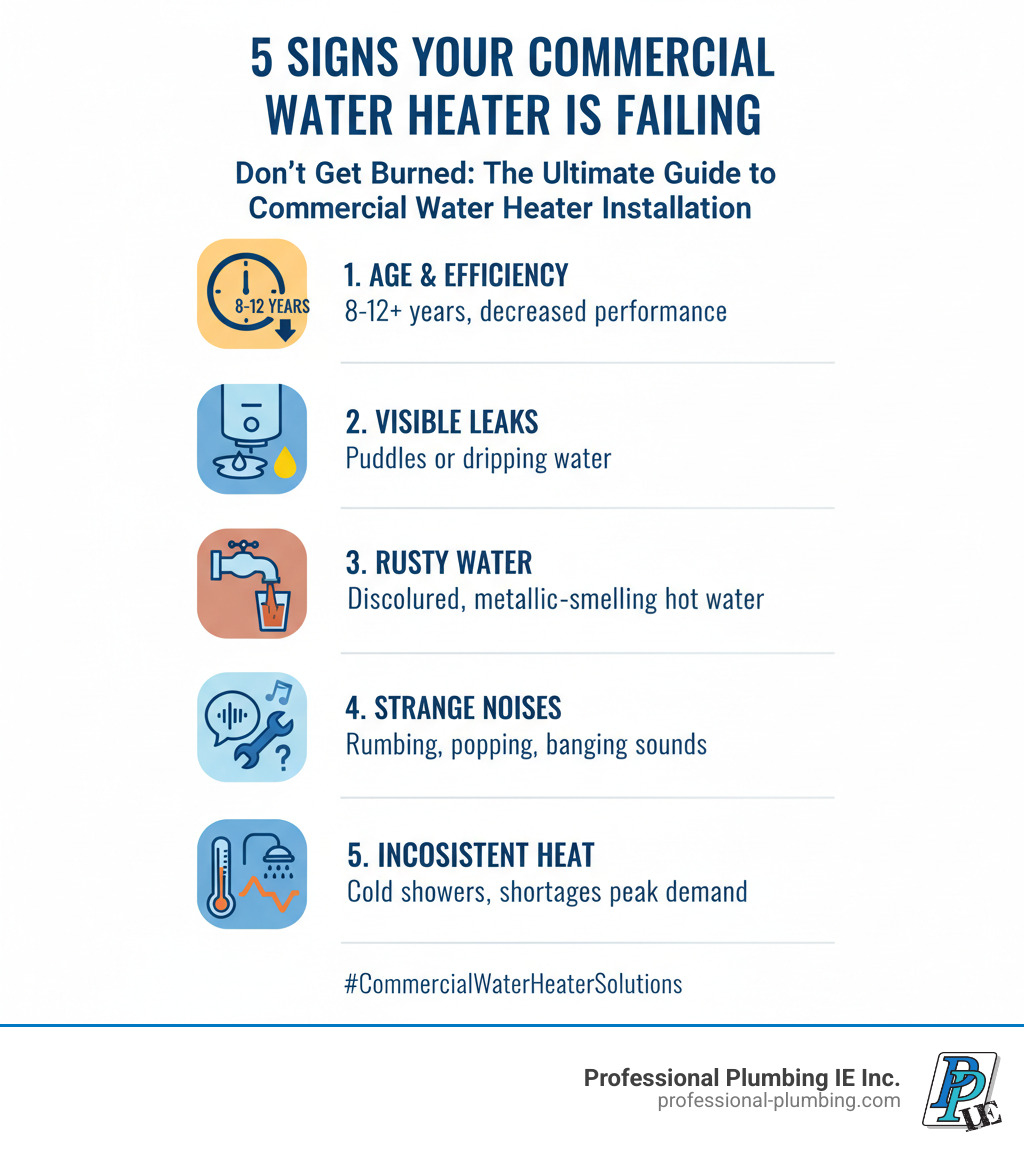
Is It Time for an Upgrade? Key Signs Your Water Heater Needs Replacing
Even the best commercial hot water heater has a finite lifespan. Most units last 8 to 12 years, though proper maintenance can extend this to 15 years. As a water heater ages, its efficiency drops, operating costs rise, and the risk of a sudden breakdown increases. A failure isn’t just an inconvenience; it’s a business-stopping emergency that can damage your reputation and bottom line.
If you want to dig deeper into evaluating whether your current system is on its last legs, check out this helpful guide on how to know when it’s time to replace your commercial water heater.
Telltale Signs of Failure
When you spot any of these warning signs, it’s time to start planning for a commercial hot water heater replacement.
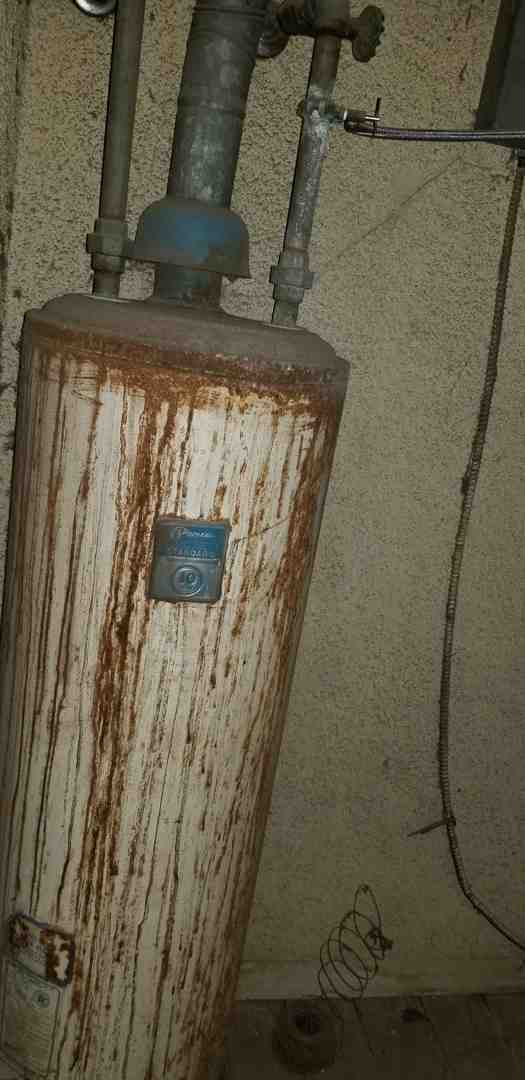
Leaks or pooling water around your unit are never a good sign. Even a small puddle indicates a potential crack in the tank or a failing connection. What starts as a drip can quickly become a flood, leading to costly water damage.
Rusty or discolored water from your hot taps tells you the inside of your tank is corroding. This indicates the inside of your tank is corroding, compromising its structural integrity.
Strange noises—rumbling, popping, or banging—are caused by sediment buildup at the bottom of the tank. The sediment forces the system to work harder, wasting energy and shortening its lifespan.
Inconsistent water temperature is incredibly frustrating. Fluctuating temperatures can mean failing heating elements, a faulty thermostat, or an undersized unit.
Frequent repairs add up fast. If repair calls are becoming common, a new, efficient unit is often more cost-effective than continuing to fix an old one.
Increased energy bills without a corresponding increase in usage should be a red flag. An aging water heater loses efficiency and works harder to heat water, leading to unexplained increases in your utility bills.
Factors That Influence Lifespan
Several factors determine how long your unit will last.
Water quality makes a huge difference. Hard water, common in Riverside, contains minerals that create sediment buildup and accelerate corrosion, shortening the unit’s life.
Maintenance frequency is the biggest factor you can control. Regular professional maintenance—like flushing the tank and replacing anode rods—can add years to your water heater’s life.
Usage levels impact wear and tear. A busy hotel or restaurant puts more strain on a water heater than a small office, which can shorten its lifespan.
Installation quality is foundational. A poor installation can lead to premature failure, inefficiency, and safety hazards. Professional installation ensures your unit operates correctly from the start.
At Professional Plumbing IE Inc., we’ve spent nearly 40 years helping Riverside businesses keep their hot water flowing reliably. For more information about how we can help, visit our dedicated Water Heater services page.
Selecting the Right Unit: A Buyer’s Guide for Businesses
Choosing the right commercial water heater involves matching a system to your business’s specific needs while controlling energy costs. With water heaters accounting for a significant portion of energy use, the right choice directly impacts your bottom line. Let’s explore the options to find the best fit for your business.
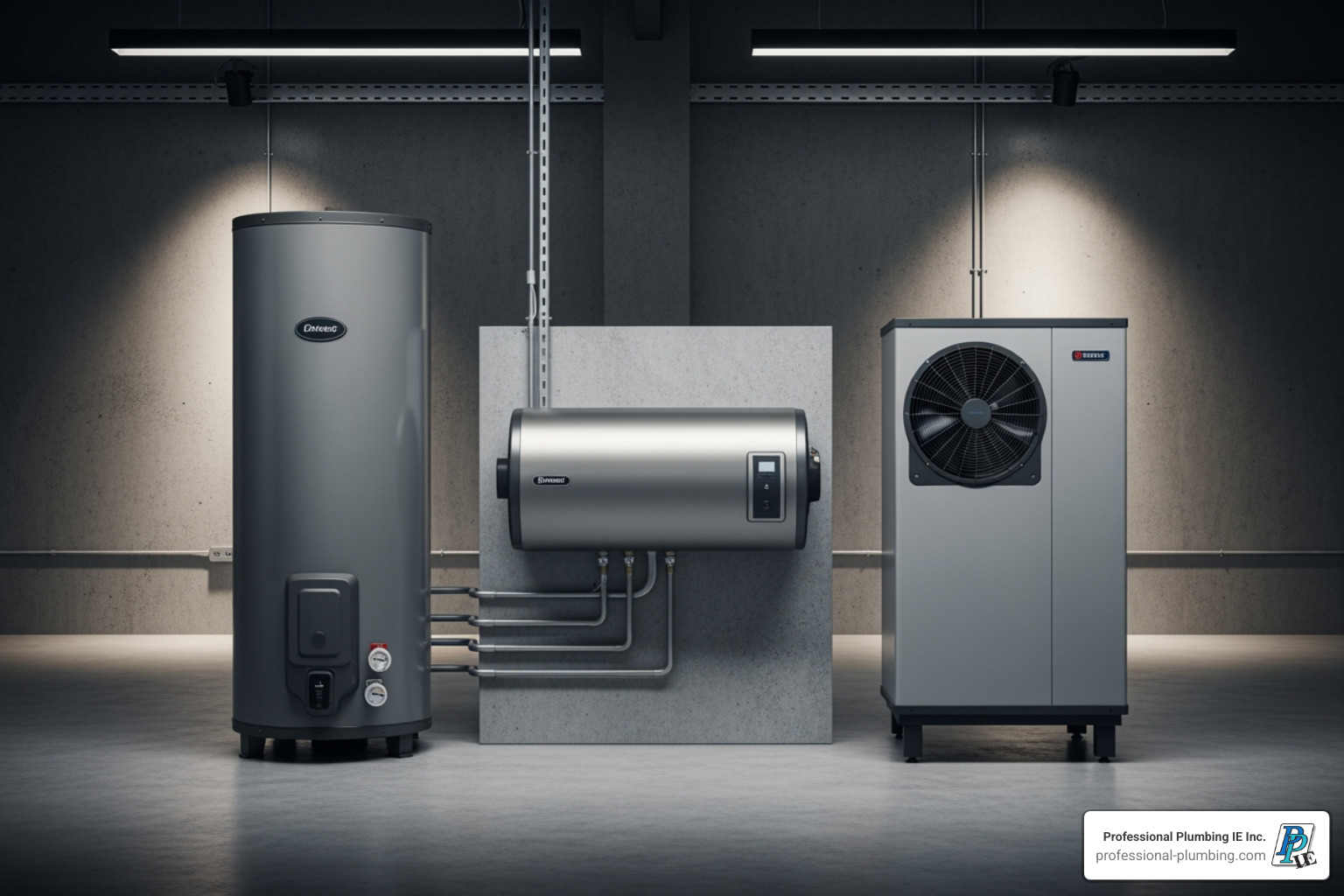
Choosing the Best Commercial Water Heater for Your Business
Let’s break down the main types of commercial water heaters. Understanding their differences will help you make an informed decision for your commercial hot water heater replacement.
| Feature | Tank-Style Water Heater | Tankless Water Heater | Commercial Heat Pump Water Heater |
|---|---|---|---|
| Hot Water Delivery | Stores and heats water, provides a large reserve for peak demand. | Heats water on demand, endless hot water supply. | Uses ambient air to heat water, highly efficient. |
| Upfront Cost | Generally lower | Higher | Higher |
| Operating Cost | Higher due to standby heat loss | Lower (up to 24-34% more efficient than standard models) | Significantly lower (up to 4 times more efficient than electric tanks) |
| Lifespan | 8-12 years (up to 15 with maintenance) | 20+ years | 10-15 years |
| Footprint | Large (requires significant space for the tank) | Compact (wall-mounted, saves space) | Medium to large (requires space for the unit and air circulation) |
| Efficiency | Lower due to standby heat loss. storage water heaters often incur standby heat loss. | High, as it only heats water when needed. according to the Office of Energy Efficiency & Renewable Energy | Very high, especially in moderate climates. |
| Fuel Type | Natural Gas, Propane, Electric | Natural Gas, Propane, Electric | Electric |
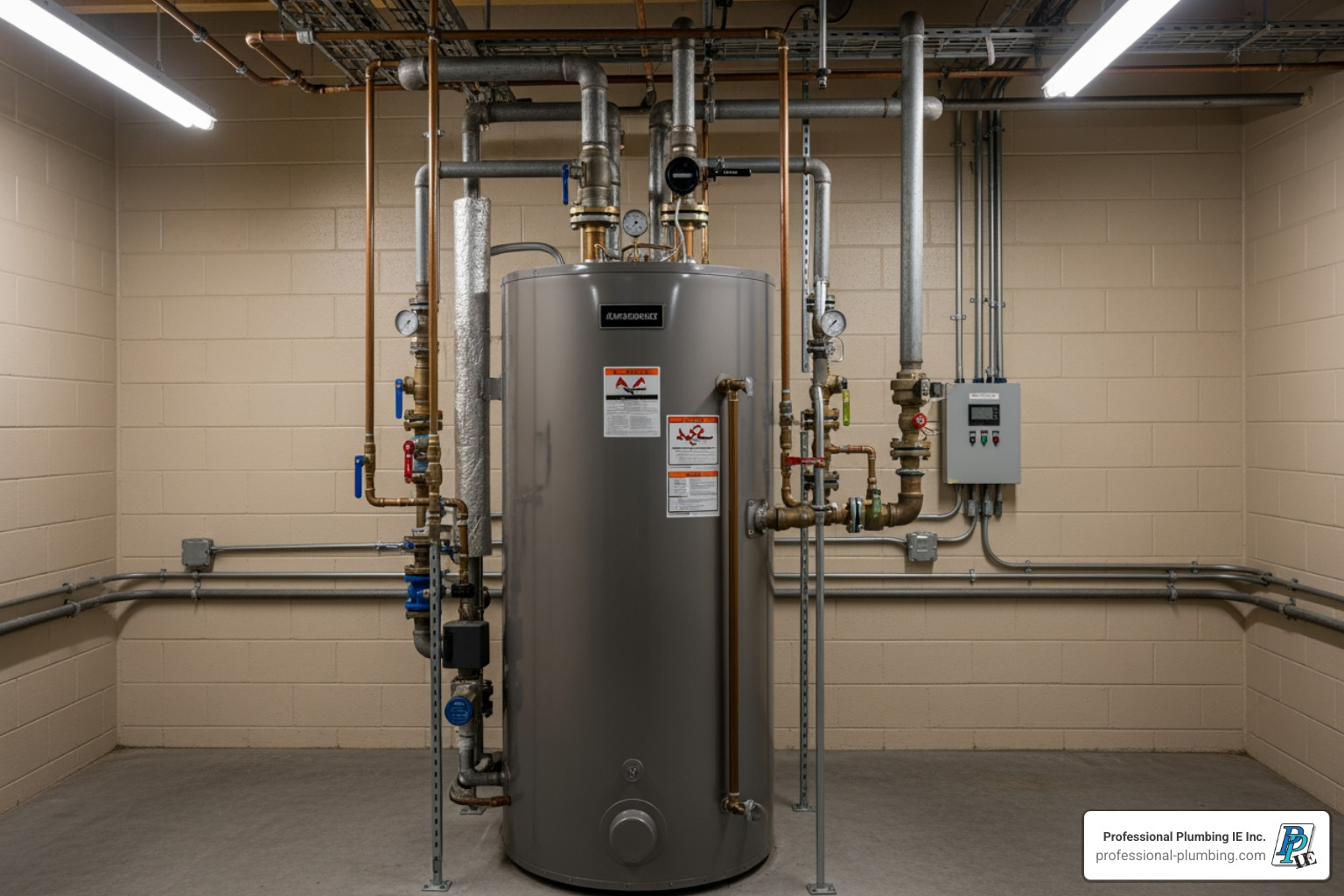
Tank-style water heaters are the traditional choice. These units store a large volume of hot water, making them ideal for businesses with predictable peak demand, like hotels or restaurants. However, they constantly use energy to keep the water hot, resulting in “standby heat loss.”
Tankless water heaters heat water instantly on demand, eliminating standby heat loss. This makes them 24 to 34 percent more energy-efficient for high-usage businesses. They are also compact, wall-mounted, and can last over 20 years. While the upfront cost is higher, the long-term energy savings are significant.
Commercial heat pump water heaters are the efficiency champions. These highly efficient units capture warmth from the surrounding air and transfer it to the water. They can be up to 4 times more efficient than traditional electric tank heaters, offering serious energy savings, especially in moderate climates like Southern California.
Key Considerations for Your Commercial Hot Water Heater Replacement
Getting these factors right ensures you won’t end up with a system that’s too small or too expensive to run.
Sizing and capacity is critical. An undersized unit won’t meet peak demand, while an oversized one wastes energy. Sizing requires calculating peak hour demand and usage patterns. For tank-style units, consider the First-Hour Rating (FHR). For tankless systems, focus on flow rate (gallons per minute) and temperature rise.
Fuel type often depends on what’s available at your facility. Natural gas and propane offer lower operating costs for high-volume users. Electric units are simpler to install but can have higher operating costs. They are available in various commercial voltages (208V, 240V, 480V, or 600V).
Energy efficiency is good for your budget. Look for ENERGY STAR certified models, which use 15% less energy than standard units. For gas heaters, check the Thermal Efficiency (TE) rating. Higher efficiency directly translates to lower monthly utility bills.
Venting options are important for gas-fired heaters. Atmospheric venting uses natural draft. Power venting uses a blower for installation flexibility. Power direct venting is a sealed system ideal for buildings with air quality concerns.
Physical space and location must be considered. Factor in the unit’s dimensions, accessibility for maintenance, and clearance requirements. Compact, wall-mounted tankless units are ideal for businesses where space is limited.
At Professional Plumbing IE Inc., we’ve helped countless Riverside-area businesses steer these decisions. We’re here to help you find the perfect solution. For more information, visit our Water Heater services page.
The Step-by-Step Process for Commercial Hot Water Heater Replacement
Replacing a commercial water heater is a complex job requiring professional expertise to ensure safety and compliance. Cutting corners can be costly.
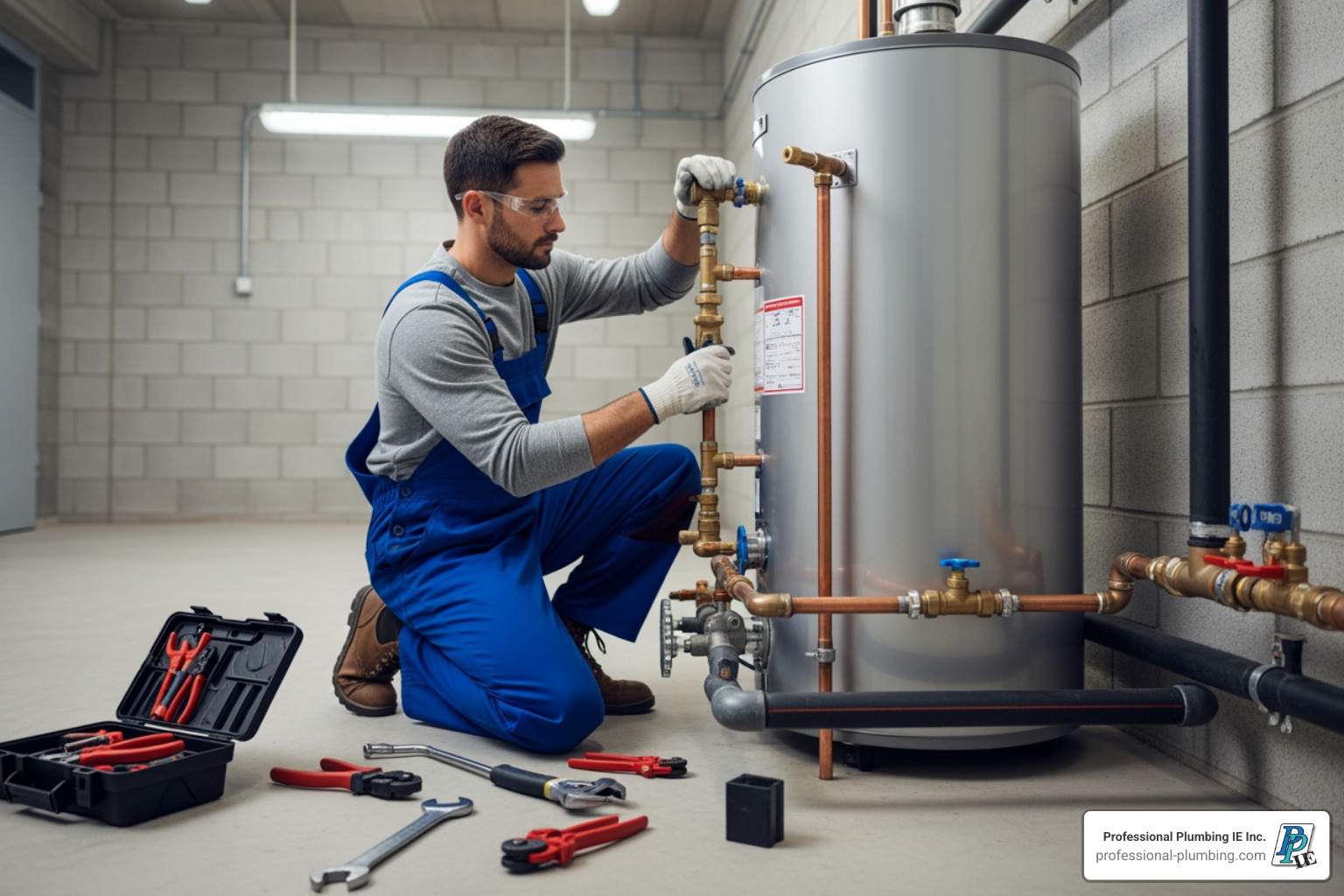
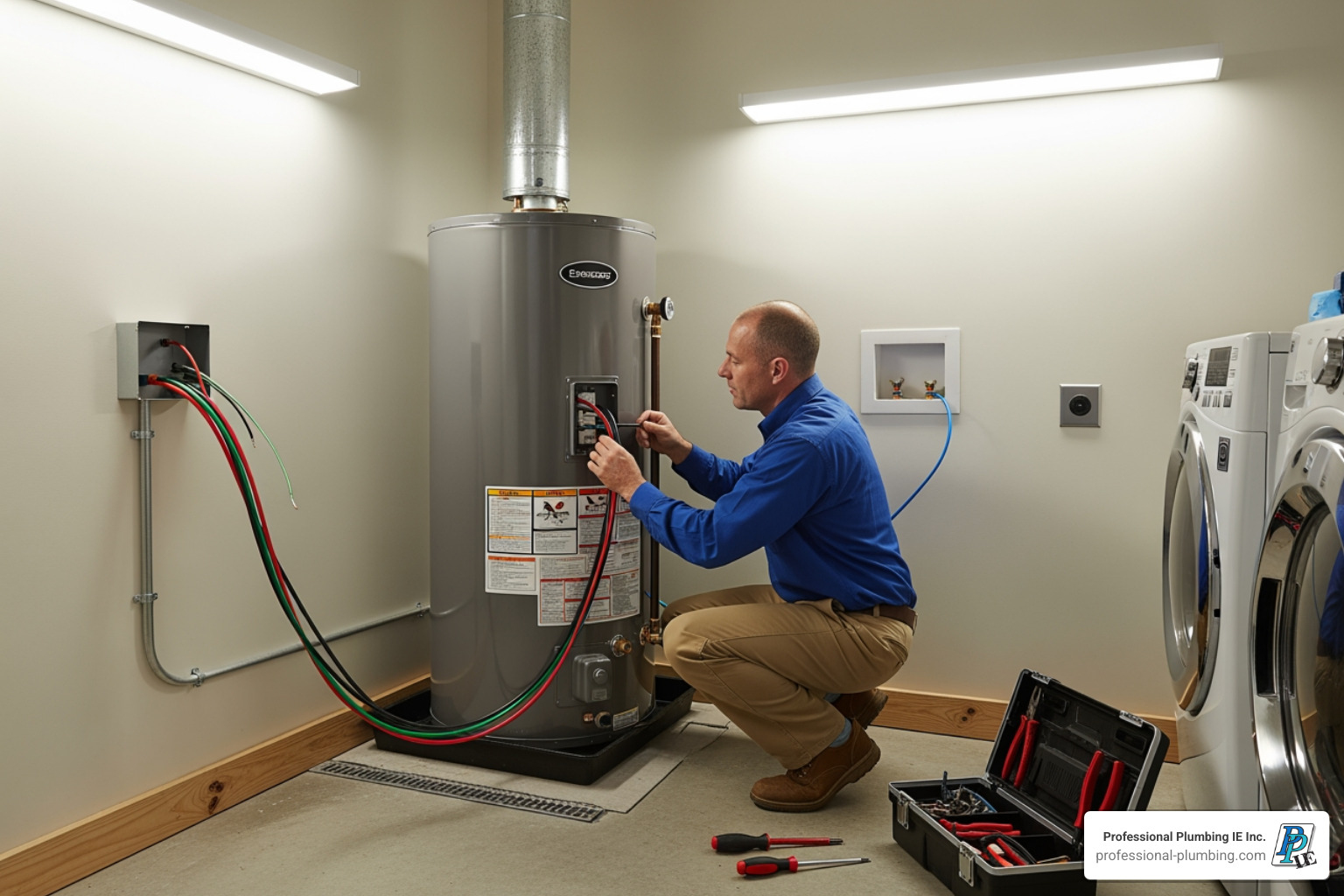
Safety comes first. We secure the proper local codes and permits for your Riverside or Corona location. The typical commercial hot water heater replacement takes about 4 to 8 hours for a standard unit, though complex installations may take longer. We work efficiently because we know downtime affects your business.
For more information about how we handle commercial installations, visit our Commercial Services page.
Pre-Installation and Removal
The process begins with a thorough site assessment to verify measurements, connections, and ventilation pathways. Next, we shut off all water, gas, and power supplies before draining the old tank. All water, gas, and electrical lines are then disconnected. Finally, we handle the safe removal and responsible disposal of the old, heavy unit.
Why Professional Installation is Crucial for a Commercial Hot Water Heater Replacement
Professional installation for a commercial hot water heater replacement is essential, not optional.
Code compliance is the first reason. Our licensed plumbers know local codes, ensuring your installation passes inspection and avoids fines or rework.
Safety risks are serious. Professional installation prevents hazards like gas leaks, fires from bad wiring, or carbon monoxide poisoning from incorrect venting.
Warranty protection depends on it. Most manufacturers require certified professional installation to honor their warranties. An improper installation can void your warranty.
Optimal performance is the final piece. A professional installation ensures your new unit operates at peak efficiency, delivering reliable hot water, minimizing energy costs, and extending its lifespan.
For expert commercial plumbing solutions throughout Riverside, check out our Commercial Plumbing in Riverside page. You can also find helpful guidance in these Installation Tips For Your Commercial Water Heater.
New Unit Installation and Testing
With the old unit gone, we carefully position the new heater, ensuring proper clearances for safety and maintenance. Connecting the plumbing involves attaching water lines and installing the critical temperature and pressure (T&P) relief valve, piping it to a safe discharge point. Fuel and electrical connections are made according to manufacturer specifications and local codes. Proper venting installation is crucial for gas units to ensure all combustion gases are safely expelled.
During system startup and testing, we fill the tank and monitor all indicators to confirm proper operation. We perform an exhaustive leak check on every connection. A final inspection verifies water temperature, pressure, and venting to ensure safe, efficient operation before we consider the job complete. That’s the Professional Plumbing IE Inc. difference—thorough, professional service backed by nearly 40 years of experience.
Maximizing Your Investment: Post-Installation Maintenance
You’ve made a smart investment in a new commercial water heater. Now, to truly maximize that investment, regular maintenance is key. It’s not just about extending its lifespan; it’s about maintaining efficiency, ensuring consistent hot water, and protecting your warranty.
Essential Maintenance Checklist
Implement these practices to keep your commercial water heater running optimally:
- Regularly check the T&P valve: The temperature and pressure relief valve is a critical safety device. Test it annually by gently lifting the lever to ensure it opens and closes freely. If it doesn’t release water, it may need replacement.
- Flush the tank semi-annually: Sediment buildup at the bottom of the tank reduces efficiency and can lead to premature failure. We recommend flushing a few gallons of water from the tank every six months to remove these deposits. This also helps prevent those strange rumbling noises.
- Inspect anode rods every 3 years: The anode rod is often called the “sacrificial rod” because it corrodes, protecting the tank lining. It should be inspected and typically replaced every three years, or sooner if water quality is poor, to prevent tank corrosion.
- Check for leaks and corrosion: Periodically inspect the tank, pipes, and connections for any signs of leaks, rust, or corrosion. Addressing these issues early can prevent major problems.
- Schedule professional annual inspections: Even with regular internal checks, an annual inspection by our qualified technicians is invaluable. We can identify subtle issues, optimize settings, and perform more complex maintenance tasks to ensure your system’s longevity and efficiency.
Frequently Asked Questions about Commercial Water Heater Replacement
We know that deciding on a commercial hot water heater replacement brings up plenty of questions. After nearly 40 years serving businesses throughout Riverside and Corona, we’ve heard them all. Here are the answers to what our clients ask us most often:
What is the average lifespan of a commercial water heater?
The average lifespan is 8 to 12 years. With regular professional maintenance, this can be extended to 15 years or more. Key factors influencing longevity include water quality, usage intensity, and the quality of the initial installation.
How long does the replacement process take?
A standard replacement of a similar tank-style unit typically takes 4 to 8 hours. The process can take longer for more complex situations, such as upgrading to a tankless model, difficult access to the unit, or if new plumbing, electrical, or venting work is required. We provide a realistic timeframe during our assessment to minimize business disruption.
What are the main benefits of replacing an old commercial water heater?
The primary benefits are improved performance and cost savings.
- Improved energy efficiency: Modern units, especially ENERGY STAR certified models, use up to 15% less energy, leading to significant long-term savings on utility bills.
- Lower operating costs: A new, efficient unit reduces energy consumption and eliminates the expense of frequent repair calls for an aging system.
- Increased reliability and safety: A replacement provides a consistent hot water supply, preventing operational disruptions. New units also feature updated safety components and comply with current building codes, giving you peace of mind.
At Professional Plumbing IE Inc., we’ve been helping Riverside-area businesses make smart decisions about their water heating systems for nearly four decades. We’re here to answer your questions, assess your needs, and ensure your commercial hot water heater replacement is done right the first time.
Ensure a Flawless Installation for Your Riverside Business
Your business deserves hot water that works—every single day, without fail. That’s what a commercial hot water heater replacement delivers when it’s done right. Throughout this guide, we’ve walked you through recognizing the warning signs of a failing unit, choosing an efficient replacement that matches your needs, and understanding why professional installation makes all the difference.
The benefits are clear: improved energy efficiency that can cut your utility bills by 15% or more, increased reliability that keeps your operations running smoothly, and consistent hot water that your customers and staff can count on. No more unexpected cold showers. No more emergency repair calls. No more worrying whether your water heater will make it through another busy season.
We also know that avoiding business downtime isn’t just important—it’s essential. A restaurant without hot water can’t serve customers. A hotel without hot water faces angry guests. A salon without hot water simply can’t operate. That’s why timing and expertise matter so much.
At Professional Plumbing IE Inc., we’ve been keeping businesses like yours running for nearly 40 years. We’re not a faceless corporation—we’re a family-owned and operated company right here in Riverside, serving Corona and the surrounding Inland Empire with the same commitment we’d bring to our own family’s business. Our highly trained team knows commercial water heaters inside and out, and we stand behind every installation with our guaranteed quality service.
We work efficiently to minimize disruption. We follow every code to the letter. We test thoroughly before we leave. And we’re here for you long after the installation is complete, ready to help with maintenance or answer any questions.
Don’t wait for your water heater to fail at the worst possible moment. Take control now. Schedule your commercial water heater replacement in Riverside today! Let’s make sure your business has the reliable hot water it needs—starting right now.


Pingback: Business Plumbing Services: #1 Smart Choice
[…] Commercial Hot Water Heater Replacement […]