Cost of Adding a Gas Line: Top 5 Smart Factors
Understanding the Investment in Natural Gas Infrastructure
The cost of adding a gas line typically ranges from $271 to $936 nationally, with an average of $598. In California, homeowners can expect to pay between $500 and $2,000 or more, depending on project complexity.
Quick Cost Breakdown:
- Per Linear Foot: $15 to $25
- Labor: $45 to $200 per hour
- Permits: $100 to $300
- Gas Meter Installation: $300 to $600
- Trenching: $5 to $12 per linear foot
Thinking about installing a gas line in your Riverside home? You’re not alone. More homeowners are making the switch to natural gas for its efficiency and cost savings. Whether you’re connecting a new stove, upgrading to a gas water heater, or adding an outdoor grill line, understanding the costs upfront helps you plan and budget effectively.
Natural gas offers real benefits. It’s more efficient than electricity for heating, works during power outages, and typically costs less to operate over time. But the initial investment can feel overwhelming without a clear picture of what drives the price.
The total cost depends on several factors: how far the line needs to run, what type of pipe material you choose, how many appliances you’re connecting, and whether you’re dealing with easy terrain or need to dig through concrete. Labor costs vary based on your plumber’s experience level, and you’ll need to factor in permits and inspections to keep everything up to code.
In this guide, we’ll break down every cost component so you know exactly what to expect. No surprises, no hidden fees—just straightforward information to help you make the right choice for your home.
Breaking Down the National Average: What’s in the Price Tag?
When you’re planning to add a gas line to your home, it helps to understand where your money is actually going. The cost of adding a gas line isn’t just about buying a pipe and connecting it. You’re paying for quality materials, skilled craftsmanship, official permits, and safety inspections that protect your family and your investment.
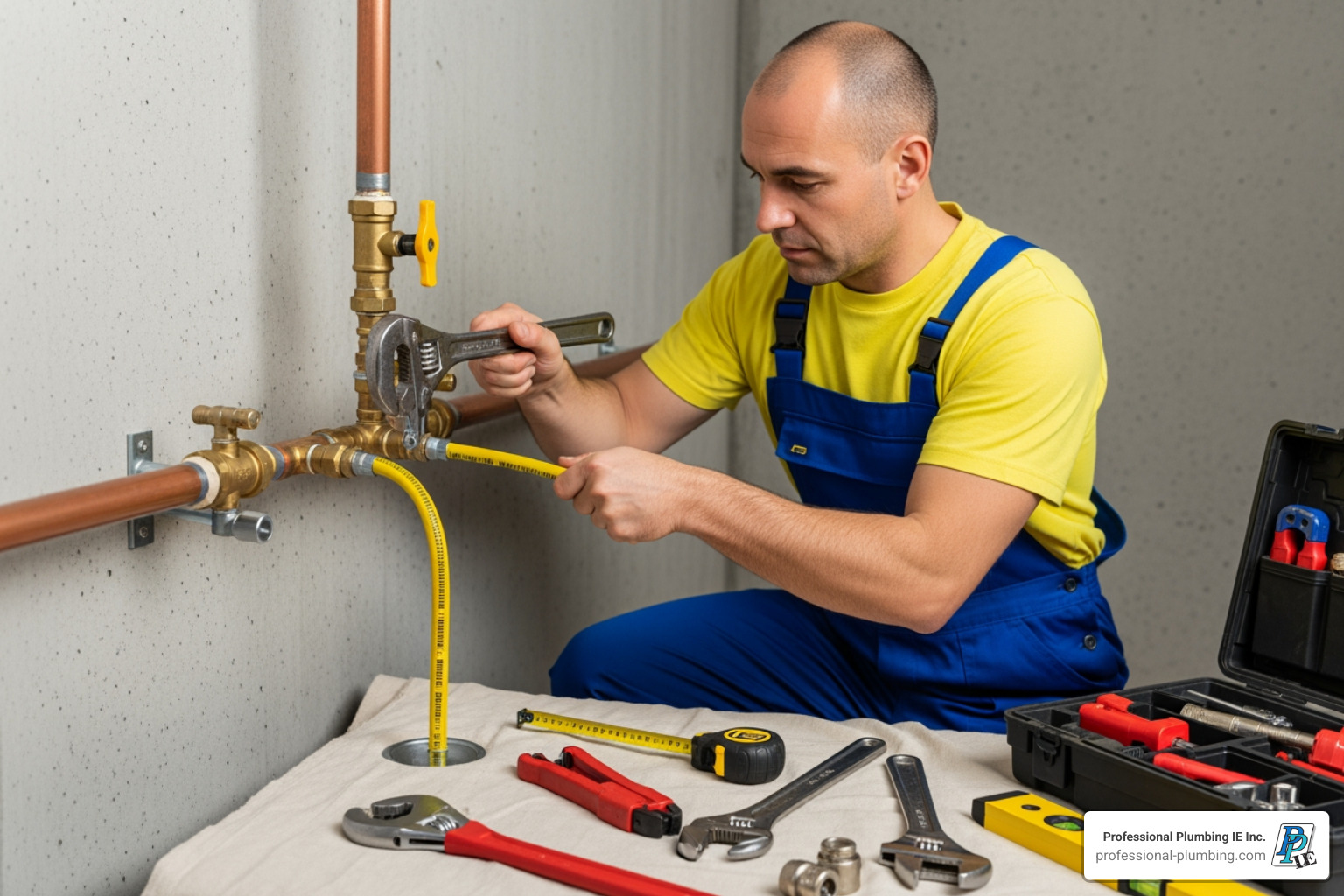
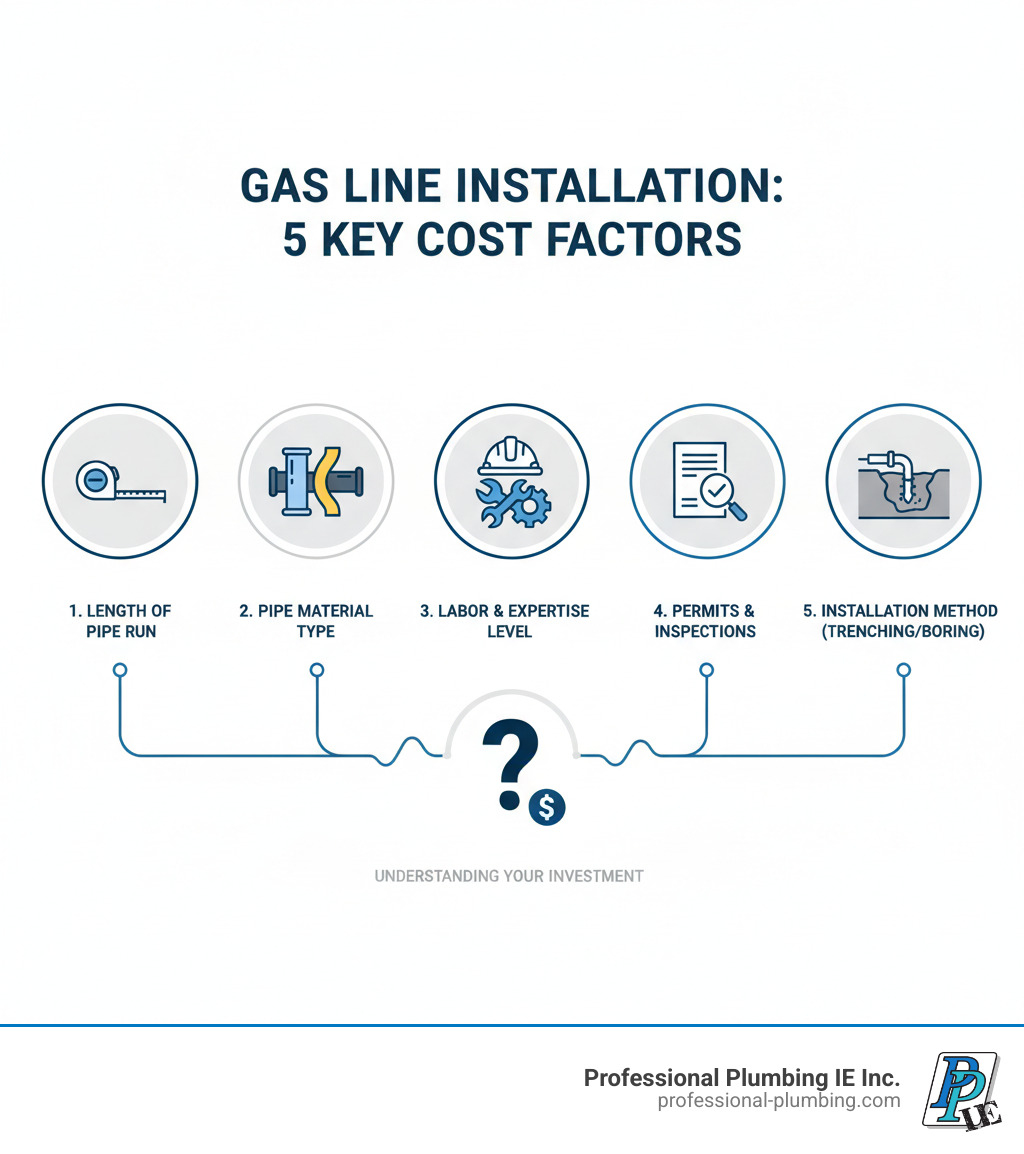
Most homeowners pay between $15 and $25 per linear foot for gas line installation. This rate typically covers materials, labor, and the basic work of running a new line. But like most home improvement projects, the devil is in the details. Let’s break down each piece of the puzzle so you know exactly what you’re paying for.
Average Cost to Install a Gas Line
The national average for gas line installation sits at $598, with most homeowners spending somewhere between $271 and $936. But here’s the thing: averages only tell part of the story.
Here in California, where Professional Plumbing Inc. serves Riverside, Corona, Fountain Valley, and Orange County, you’ll typically see costs ranging from $500 to $2,000 or more. Why the difference? Regional factors like higher labor rates, stricter building codes, and local material costs all play a role.
For individual piping runs—say, connecting a single appliance like a stove or dryer—you’re looking at $749 to $917 per run for straightforward installations. The per-linear-foot cost of $15 to $25 remains your baseline, but various factors can nudge that number up or down depending on your specific situation.
Labor Costs: The Price of Professional Expertise
When it comes to gas line installation, you’re not just paying someone to twist pipes together. You’re investing in expertise that could literally save your life. Natural gas is incredibly useful, but it demands respect and knowledge to handle safely.
Master plumbers charge between $45 and $200 per hour, and for good reason. These experienced professionals have spent years mastering their craft. They understand gas pressure systems, safety protocols, and local building codes inside and out. When you hire a master plumber, you’re getting someone who can spot potential problems before they become dangerous.
Apprentice and journeyman plumbers typically charge less, but they work under supervision to ensure everything meets our high standards. The hourly rate you’ll pay depends on several factors: the plumber’s experience level, how complex your project is, and even where you live in Southern California.
Here’s what you need to know: hiring a licensed professional isn’t optional. It’s the only way to guarantee your installation is safe, up to code, and will pass inspection. Plus, when something involves natural gas, cutting corners on expertise is simply not worth the risk. For more information about labor costs in the plumbing industry, check out the U.S. Bureau of Labor Statistics.
Pipe Material Costs: A Comparison
Not all gas pipes are created equal. The material you choose affects both your upfront costs and the long-term safety and durability of your system. Let’s look at your options:
Black iron pipe has been the workhorse of gas line installations for decades. It’s sturdy and reliable for interior lines, running about $5 to $10 per linear foot for materials. The downside? It can corrode when exposed to moisture, so it’s not ideal for outdoor or underground use. Its rigidity can also be a challenge in earthquake-prone areas of California.
Galvanized steel offers similar strength with slightly better corrosion resistance, costing $2 to $9 per linear foot. It’s a solid middle-ground option for many installations.
CSST (Corrugated Stainless Steel Tubing) is the flexible yellow-jacketed tubing you might have seen. It’s become increasingly popular because it can snake through walls and around obstacles without requiring dozens of fittings. Materials typically cost $2 to $4 per linear foot. Its flexibility also makes it a smart choice in seismic zones, as it can handle ground movement better than rigid pipes.
HDPE (High-Density Polyethylene) is the go-to choice for underground gas lines. This flexible plastic pipe resists corrosion beautifully and usually costs just $1 to $2 per linear foot. You’ll often see it used for the main service line running from the street to your meter.
Copper pipe deserves a special mention—mainly as a warning. While copper costs $2 to $6 per linear foot and offers excellent corrosion resistance, it’s rarely appropriate for gas lines and is actually illegal in many areas. Natural gas can react with copper to create harmful sulfites. If anyone suggests using copper for your gas line, ask questions and verify it meets local codes.
At Professional Plumbing Inc., we help you choose the safest, most cost-effective material for your specific situation, always ensuring full compliance with Riverside, Corona, Fountain Valley, and Orange County regulations.
Permits and Inspections: The Non-Negotiable Fees
Nobody gets excited about paperwork and inspections, but these steps are absolutely essential when you’re working with natural gas. Think of permits and inspections as your safety net—they ensure your installation meets strict standards that protect your home and family.
Permit fees typically range from $100 to $300, depending on which municipality you’re in. Whether you’re in Riverside, Corona, Fountain Valley, or elsewhere in Orange County, these fees cover the administrative costs of reviewing your project and scheduling inspections.
After the installation is complete but before any gas flows through your new line, an inspector will thoroughly examine the work. Inspection costs usually run $50 to $75. The inspector verifies that everything matches the approved plans and meets safety codes. A key part of this process is the pressure test, which confirms your new gas line is completely leak-free and can safely handle the required pressure.
The good news? We handle all the permit paperwork and coordinate with local authorities from start to finish. You don’t need to steer the bureaucracy or worry about scheduling conflicts. We make sure everything is compliant and safe, giving you complete peace of mind.
Key Factors That Influence the Total Cost of Adding a Gas Line
You know how every home improvement project seems to have its own personality? Well, the cost of adding a gas line is no different. Just like planning a road trip, you can’t really nail down the price until you know where you’re going, what route you’re taking, and what kind of vehicle you’ll be driving.
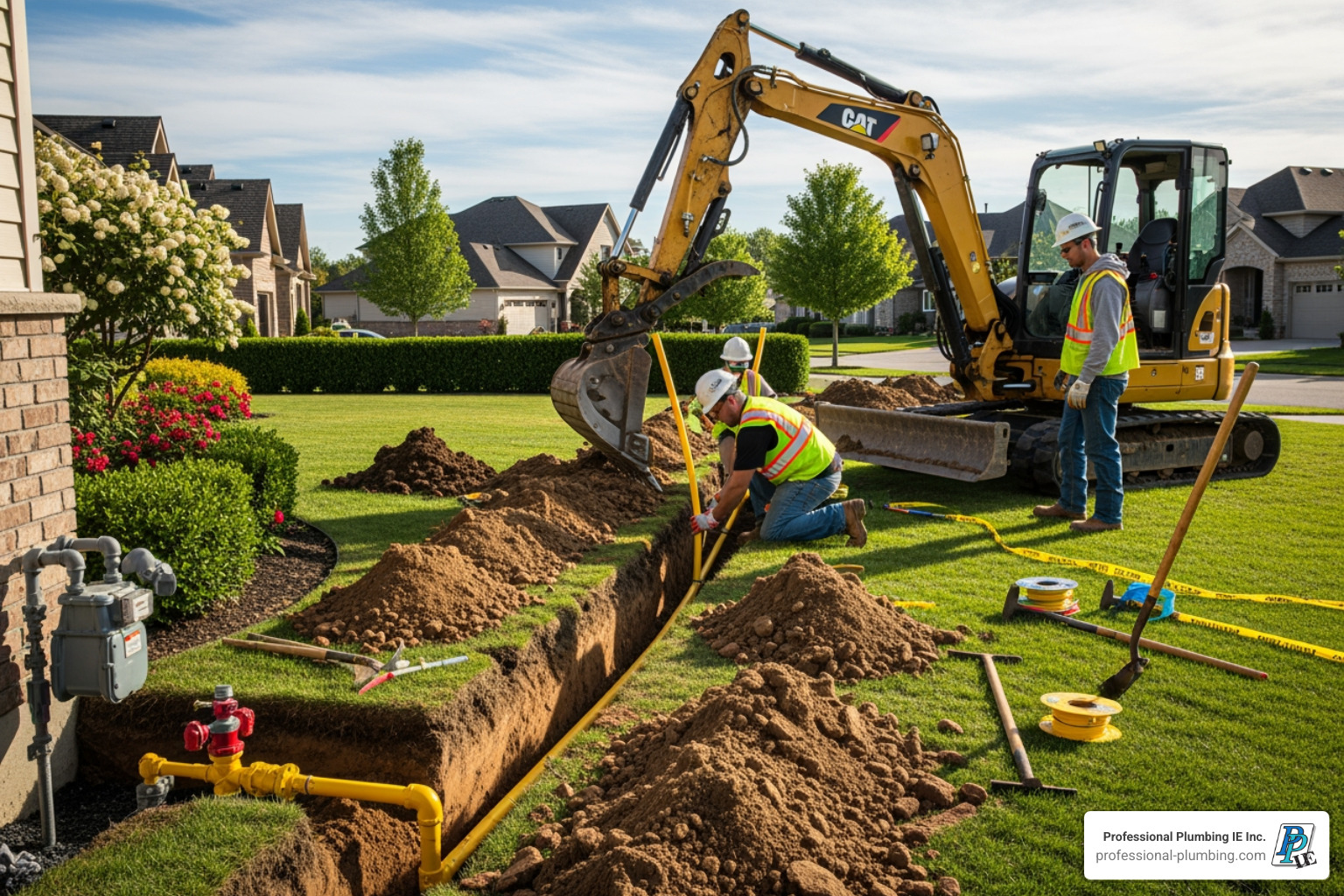
Several variables come into play when we’re estimating your gas line installation. The complexity of the work, how far the line needs to run, whether we’re digging or drilling, and how many appliances you want to connect all factor into the final number. And yes, there are sometimes those surprise costs that pop up along the way—but we’ll walk you through those too.
Understanding these factors upfront means no unwelcome surprises when you see the final invoice. Let’s break down what really drives the cost of your project.
Project Scope: New Installation vs. Moving a Gas Line
Starting from scratch is a different ballgame than rearranging what’s already there. If you’re installing a completely new gas line—say, running one from your meter to that beautiful new gas range you’ve been eyeing—you’re typically looking at $15 to $25 per linear foot. This covers everything: new pipe, fittings, connections, and the skilled labor to make it all work safely.
But what if you’re just moving things around? Maybe you’re remodeling your kitchen and need to shift the gas line a few feet to accommodate new cabinets. The good news? Moving an existing line usually costs about the same—$15 to $25 per linear foot. Even though it’s technically a relocation, we still need to disconnect the old line, run new pipe, reconnect everything, and pressure test it all. The labor and materials involved are quite similar to a new installation.
Now, here’s where it can get a bit trickier. If that line needs to snake through finished walls, squeeze under flooring, or steer around other utilities, the complexity goes up. More complexity means more time, and more time means higher labor costs. And if you’re moving a line, we’ll need to properly cap off the old connection—that runs $75 to $150. It’s a small but essential safety step that prevents any gas from escaping where it shouldn’t.
Installation Method: Trenching and Beyond
How we get that gas line from your meter to your appliances makes a real difference in your final cost. The path we take depends largely on your property’s layout and what’s in the way.
For underground lines—like when you’re adding gas to an outdoor kitchen or detached garage—we typically use traditional trenching. This means digging a ditch to lay the pipe safely underground. Trenching costs run $5 to $12 per linear foot. In California, we need to bury underground gas mains at least 24 inches deep, while other running pipes require a minimum of 18 inches of cover. These depths aren’t arbitrary—they’re designed to protect the lines from damage and, in our earthquake-prone region, provide some flexibility during seismic activity.
For interior lines running through your basement or crawl space, we can often install pipes above ground. This avoids the whole digging situation entirely, which saves both time and money.
But what about when you need a gas line under your beautiful stamped concrete patio or that newly paved driveway? That’s where directional boring comes in. Think of it as horizontal drilling—we create an underground tunnel without disturbing the surface above. While this specialized technique requires advanced equipment and expertise (which means it costs more than traditional trenching), it often saves you money in the long run. Why? Because you won’t be paying to tear up and then repair expensive hardscaping or asphalt.
We’ll assess your property and recommend the method that makes the most sense for your situation, balancing upfront costs with potential restoration expenses.
Appliance Connections: Number and Type Matter
Every appliance you want to connect adds another piece to the puzzle. And some appliances are hungrier for gas than others. We measure this appetite in BTUs (British Thermal Units), and higher-BTU appliances need larger pipes to ensure they get adequate gas flow.
Your kitchen stove is one of the most common gas line installations we do. These typically cost around $20 per linear foot and usually use a smaller ½-inch pipe, keeping costs reasonable. Connecting a gas dryer runs about the same—$20 per linear foot—and it’s a smart efficiency upgrade.
Thinking about a water heater? If you’re switching from electric to gas or replacing an old gas unit, expect around $20 per linear foot for the line. That high-efficiency tankless water heaters have bigger BTU demands, which might require ¾-inch or 1-inch pipes instead of the standard ½-inch. That means slightly higher material costs, but the long-term energy savings often make it worthwhile. The U.S. Department of Energy has great information on comparing different water heating options.
For those of you dreaming of backyard entertaining, adding a gas line to your outdoor grill or fire pit costs $20 to $25 per linear foot. No more running out of propane mid-cookout! These installations typically involve underground trenching and weather-resistant piping designed to handle outdoor conditions. Installing a gas furnace line? That’s also around $20 per linear foot.
The bottom line: each appliance connection adds to the total length of pipe we need to run. And if you’re connecting multiple appliances, bundling them into one project can sometimes create labor efficiencies that save you money.
The Final Touches: Hidden Costs to Budget For
We wish every project was as simple as running a pipe and calling it a day. But the reality is, gas line installations sometimes involve collateral impacts—things that aren’t immediately obvious when you’re getting that initial quote.
If we’re trenching through your yard, landscaping repairs become part of the equation. This might be as simple as reseeding a strip of lawn for a few hundred dollars, or it could mean restoring mature gardens, irrigation systems, and decorative stonework for $10,000 or more. We always do our best to minimize disruption, but when we’re digging, some disturbance is inevitable.
For interior installations that run through walls or under floors, we might need to open up finished surfaces. Once the gas line is installed and inspected, you’ll need to repair and repaint that drywall—typically $300 to $925—or fix flooring at $2 to $30 per square foot. We make the cuts as clean as possible, but restoration work is part of the process.
Here’s something many homeowners don’t realize: your utility company usually handles the main service line from the street to your property and installs the gas meter. Often, the first 100 feet of this service line come free. But if your home is set back further from the main line, you might be responsible for the additional distance at $17 to $22 per linear foot. And while the utility company typically provides the meter, installation fees can run $300 to $600. It’s worth checking with your local utility provider about their specific policies and any associated fees before the project starts.
In rare cases—especially with complex underground runs or unexpected issues near your home’s foundation—minor foundation repairs might become necessary. These situations are uncommon, but they can be costly when they happen.
We always discuss these potential additional costs during our initial assessment. No one likes surprises when it comes to their budget, and we believe in complete transparency from the start. That way, you can plan for the full investment and make informed decisions about your project.
Natural Gas: The Smart Choice for Your Home
When you’re weighing your home energy options, natural gas consistently rises to the top as a smart, efficient, and economical choice—especially here in Riverside, Corona, Fountain Valley, and Orange County. It’s not just about convenience, though that’s certainly a bonus. Natural gas delivers real, tangible benefits that can make a meaningful difference in your home’s comfort and your monthly budget.
So what makes natural gas such an attractive option compared to electricity or other fuel sources? Let’s break it down in practical terms.
Energy Efficiency: Natural gas appliances convert fuel to energy more efficiently than their electric counterparts. A gas water heater, for example, heats water faster and maintains temperature more consistently than most electric models. Gas stoves give you instant, precise heat control that professional chefs prefer—and that home cooks quickly come to love.
Cost Savings Over Time: While the initial cost of adding a gas line requires an upfront investment, natural gas typically costs less per unit of energy than electricity. This means your monthly operating costs for heating, cooking, and hot water can be significantly lower. Many homeowners see a return on their installation investment within just a few years through reduced utility bills.
Reliability: Here’s something you might not think about until the power goes out: natural gas works during electrical outages. Your gas stove, water heater, and furnace can continue operating when the lights are off, keeping your family comfortable and fed during emergencies.
Availability and Connection: In our service areas throughout Southern California, connecting to the natural gas main is typically straightforward. Most neighborhoods already have gas infrastructure in place, making installation a manageable project rather than a major undertaking.
Installation Cost Differences: As we’ve discussed throughout this guide, the cost of adding a gas line varies based on your specific situation—typically ranging from $500 to $2,000 or more in California. While this might seem like a significant expense, it’s a one-time investment that opens the door to ongoing savings and improved home functionality.
Environmental Considerations: Natural gas burns cleaner than other fossil fuels, producing fewer emissions. While it’s not a renewable resource, it’s often considered a more environmentally friendly option than coal-generated electricity, depending on your local power grid’s energy mix.
The bottom line? Natural gas offers a compelling combination of efficiency, economy, and reliability that makes it worth serious consideration for any homeowner looking to upgrade their appliances or reduce their energy costs. Whether you’re renovating your kitchen, replacing an old water heater, or simply looking for ways to cut your utility bills, natural gas deserves a place in the conversation.