Temporary Water Heater: Top Portable Power
No Hot Water in Riverside? Your Guide to a Temporary Water Heater
Waking up to a cold shower in your Wood Streets home in Riverside or having your water heater give out mid-renovation in your Norco horse property is more than an inconvenience—it can stop your day in its tracks. From washing dishes after a family dinner in Eastvale to keeping a construction crew clean near the 91/15 interchange in Corona, hot water is something we simply can’t live without.
The good news is you don’t have to suffer through days of cold water while waiting for a repair or replacement. A temporary water heater is a fast, effective solution to get you through. These portable units are lifesavers for all sorts of situations: as an emergency backup when your main unit fails, to keep a kitchen or bathroom running during a remodel, for providing hot water at construction sites or outdoor events, and even for off-grid living in an RV.
But which one is right for you? A small electric unit for an indoor sink is very different from a powerful propane model needed for an outdoor shower. Choosing the wrong one can be frustrating and even dangerous. Understanding the difference between GPM, temperature rise, and power sources is key to getting the hot water you need.
Hi, I’m Chris Kirsten. For over 40 years, my family at Professional Plumbing Inc. has been helping our neighbors across the Inland Empire solve their plumbing emergencies. I’ve seen it all, from sudden breakdowns in the middle of the night to planned projects that need a temporary hot water supply. In this guide, we’ll walk you through everything you need to know to choose the right temporary solution and make sure you’re never left in the cold.
When and Why You Might Need a Temporary Hot Water Solution
A temporary water heater is a versatile tool that can be a lifesaver in many situations across our community. From Corona to Eastvale and beyond, this section explores the most common scenarios where a temporary solution is not just convenient, but essential for daily comfort and productivity.
Benefits for Specific Applications
Here’s a closer look at where these units shine:
-
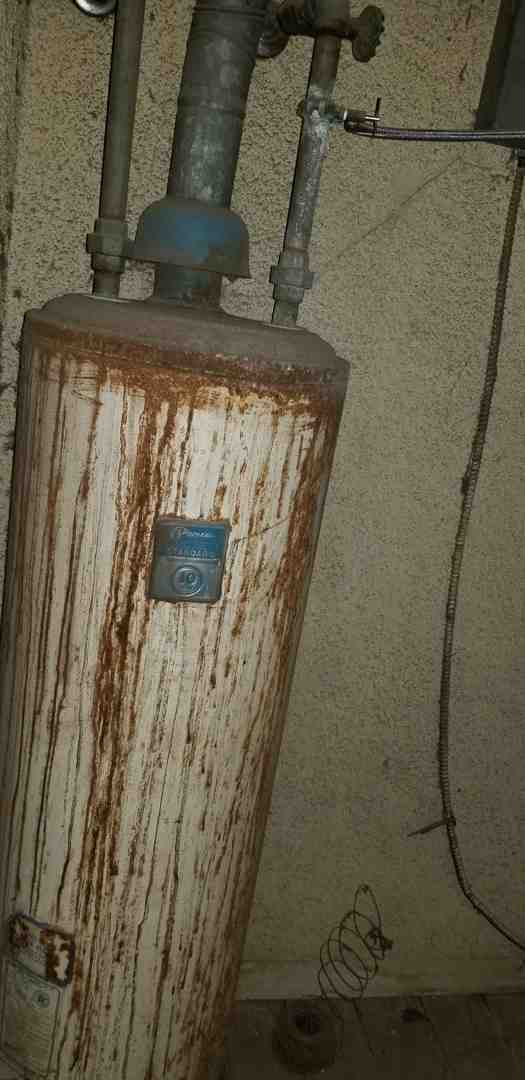
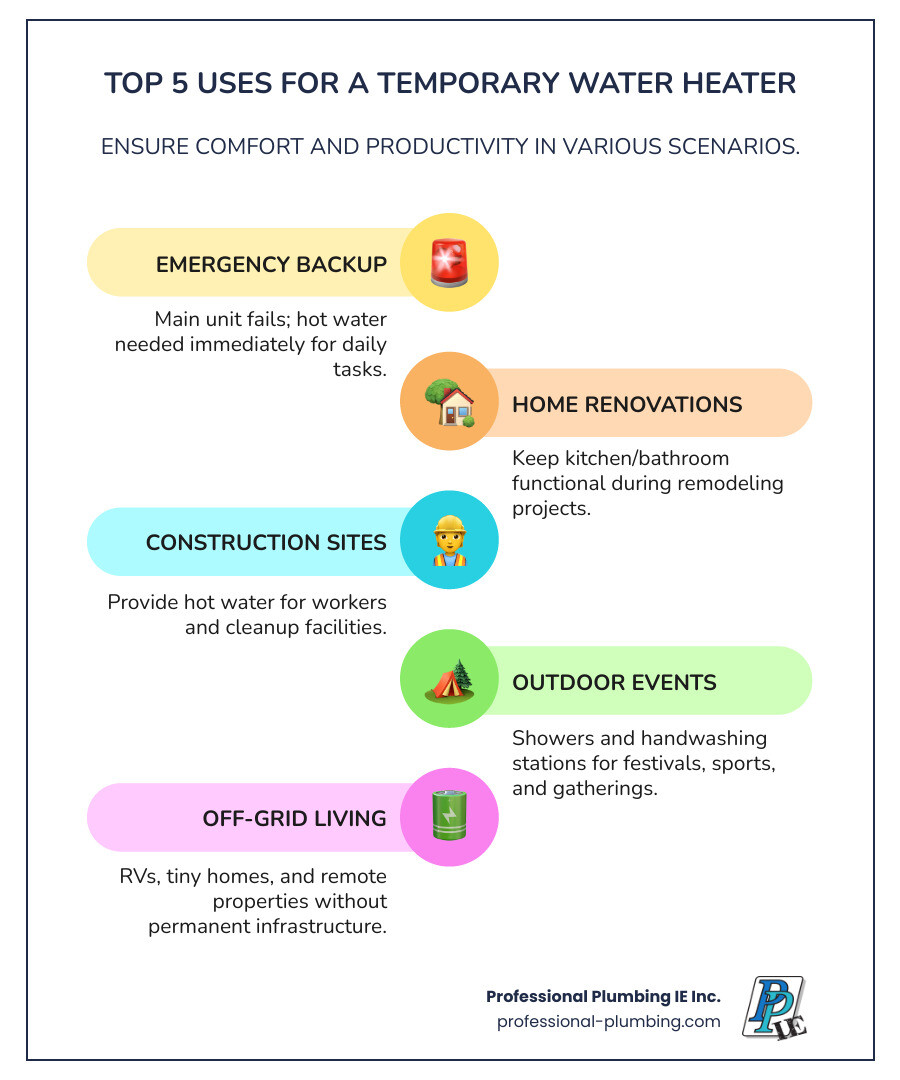
Emergency Preparedness: Imagine your water heater failing unexpectedly in your Jurupa Valley home. It’s a common occurrence, with tank water heaters lasting 8 to 12 years and tankless models up to 20 years. When your unit gives out, it’s often without warning. A temporary solution provides immediate hot water, preventing a complete disruption to your routine while you arrange for hot water tank service or a water heater replacement in Riverside. This is particularly vital in colder months or for families with young children.
-
Home Renovations: Planning a bathroom remodel in Norco or a kitchen overhaul in Mira Loma? You might need to disconnect your main hot water supply for days or even weeks. A temporary water heater can keep essential fixtures, like a utility sink or a temporary shower, functional. This allows your family to maintain some normalcy during the chaos of construction.
-
Construction Sites: For construction projects across Riverside and Corona, access to hot water is essential for sanitation, tool cleanup, and even providing comfortable washing facilities for workers. Metered water service can be temporarily provided from a fire hydrant, but a dedicated temporary water heater system offers localized, on-demand hot water where it’s needed most. These robust units can withstand outdoor conditions and provide the necessary flow for demanding tasks.
-
Outdoor Events & Recreation: From large community events in Eastvale to smaller family gatherings, outdoor activities often call for temporary hot water. Think about handwashing stations, food prep, or even temporary showers for sports teams. Portable tankless water heaters are perfect for these scenarios, offering the flexibility to set up hot water wherever it’s needed. For those who enjoy camping or RVing, a portable unit transforms a rustic experience into one with the comfort of a hot shower.
-
Off-Grid Living: For tiny homes, remote cabins, or recreational vehicles (RVs) in less developed areas, a temporary water heater is often the primary hot water source. These units are designed for efficiency and portability, making them ideal for situations where permanent plumbing and utility hookups are not feasible.
Temporary Water Service for Construction
For large-scale projects like construction sites in Riverside or Corona, a temporary water heater might be part of a broader temporary water service setup. We work with local utilities to ensure your project has the water it needs.
-
Utility Hookups: For construction projects needing water for a limited time, your local utility provider can often provide temporary water service. This typically involves setting up a metered connection.
-
Fire Hydrant Access: A common method for temporary water service is connecting to a fire hydrant. Metered water service can be provided from a fire hydrant in the vicinity of your project. To arrange this, you’ll need to provide specific information to your utility, such as the exact location of the fire hydrant, desired installation and removal dates, the purpose for water use, and your contact information. If you’re a company, a Letter of Authorization, corporate telephone number, corporate ID number, and Federal Tax ID number may also be required. You can find example of utility requirements from similar utility providers.
-
Meter Rental: There’s usually a charge for the installation, removal, and an initial period (often 30 days) of meter rental. After this initial period, meter rental is charged at the current monthly rate. These rates are updated annually, typically from July 1 through June 30.
-
Billing Process: Billing for water consumption used through temporary hydrant service continues until the service is officially removed. A refundable deposit may also be required if you’re not an approved credit customer. Payments for initial installations, relocations, and rental extensions can often be made using major credit cards like MasterCard® and VISA®.
Choosing Your Temporary Water Heater: A Breakdown of Types
Not all temporary heaters are created equal. The right choice depends on your power source, water demand, and location. From compact electric units perfect for an indoor sink to robust propane heaters for outdoor showers, we’ll help you understand the options available at local hardware stores and plumbing suppliers in Riverside and Corona.
Portable Tankless Water Heaters (Propane & Electric)
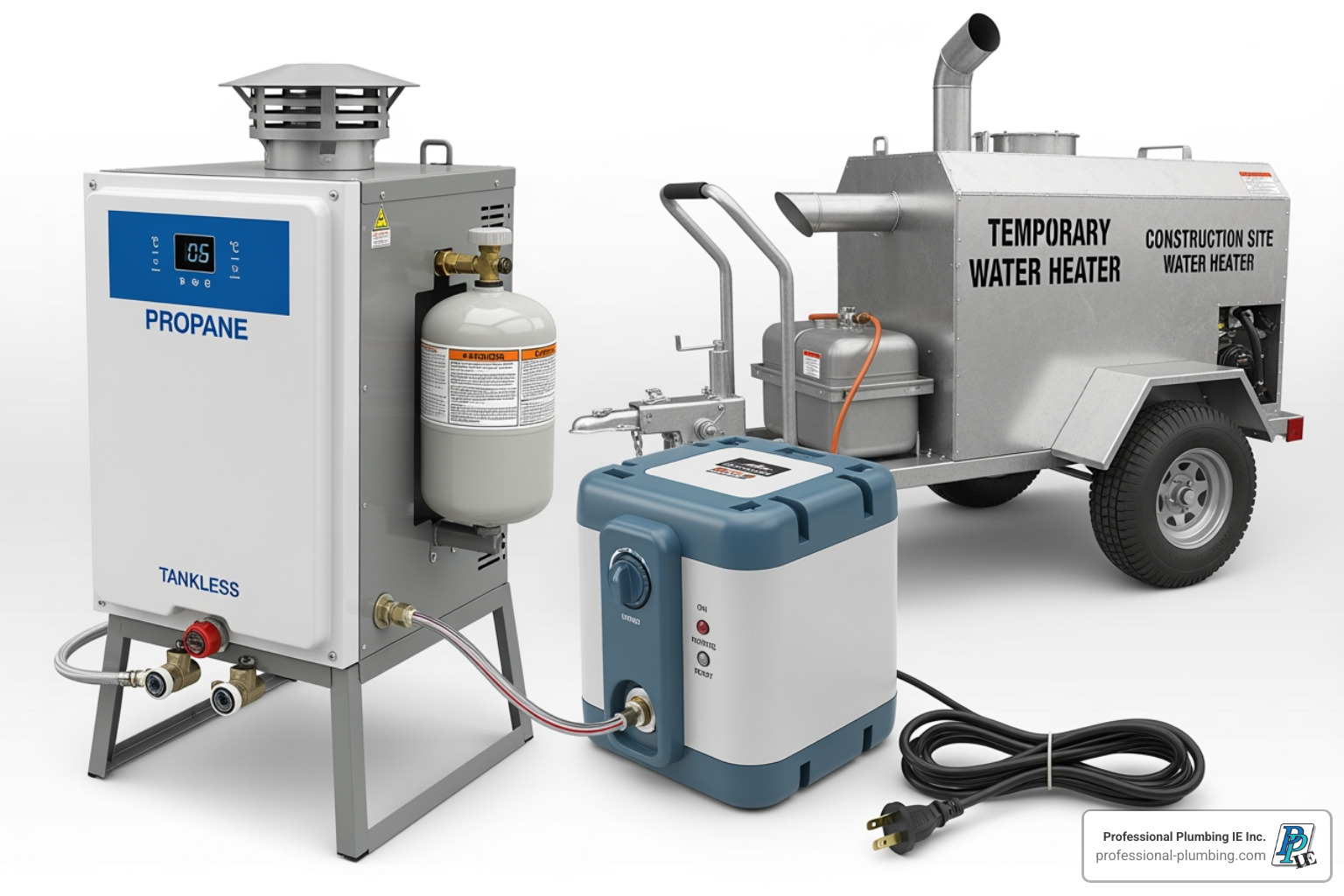
Portable tankless water heaters are the superstars of temporary hot water solutions, offering on-demand hot water without the need for a storage tank. This means you get continuous hot water, which is a major advantage for applications like showers or constant washing. You can learn more about the benefits of tankless water heaters in general.
- On-Demand Hot Water: Unlike traditional tank heaters that can run out of hot water, these units heat water as it flows through, ensuring a continuous supply.
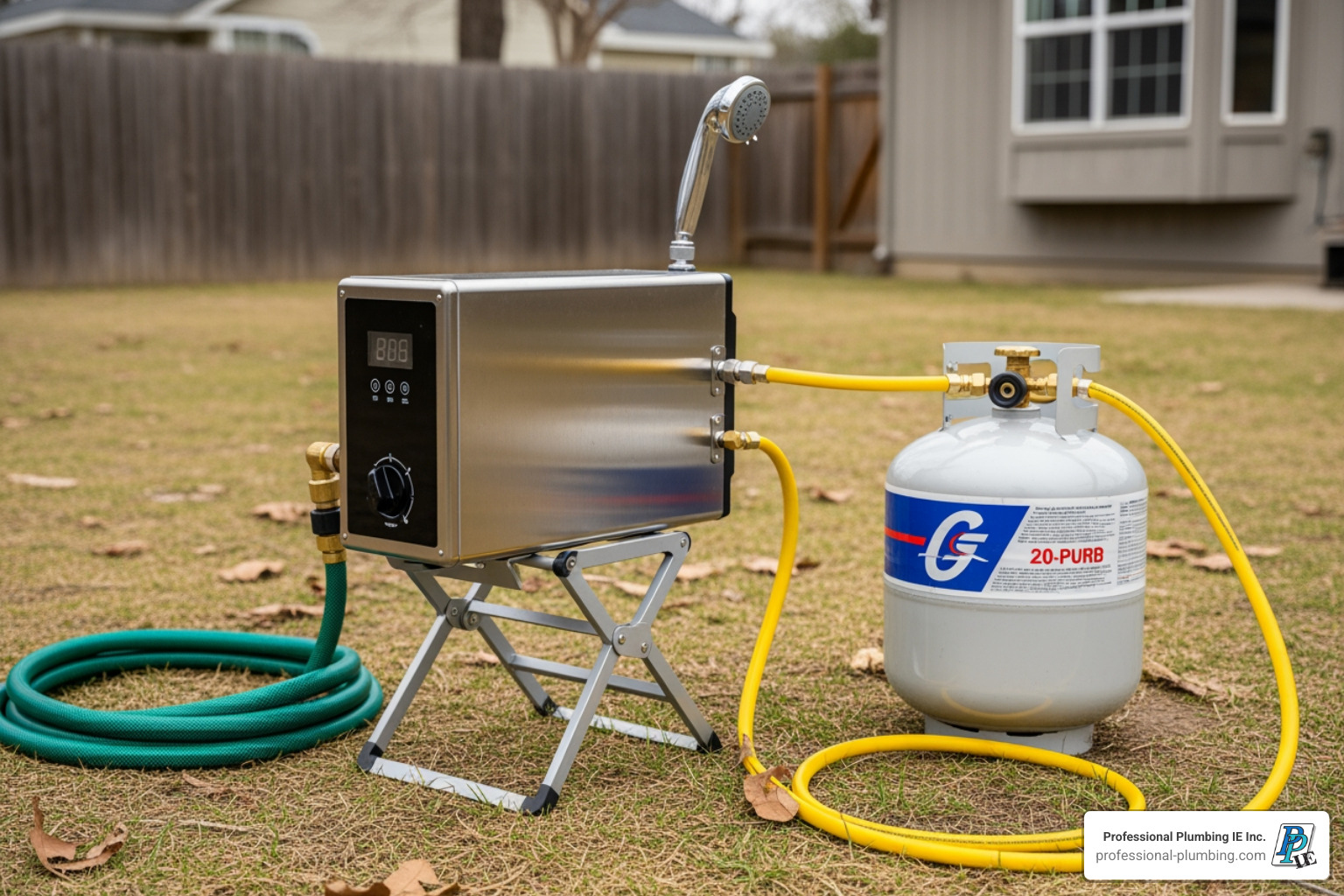
- Propane for Outdoor Use: Most powerful portable tankless units are propane-fired. These are excellent for outdoor use at construction sites, camping, or events. However, it’s crucial to remember that propane-fired units produce carbon monoxide and must be used outdoors in a well-ventilated space only. Never use them indoors or in enclosed areas like tents or RVs, as this can be fatal.
- Electric for Indoor Use: Smaller electric portable tankless units are available and can be safely used indoors, typically for single fixtures like a handwashing sink. They generally have lower GPM outputs but are perfect for point-of-use applications where only a small amount of hot water is needed.
- Portability: These units are designed to be lightweight and easy to move, often weighing under 25 pounds. You can find a wide selection of portable water heaters at Home Depot or other local retailers in our service areas like Eastvale or Jurupa Valley.
- Common Features: Many portable tankless units come with convenient features such as a Digital Display for temperature, Overheat Protection to prevent scalding, and Automatic Shut-Off for safety if the flame goes out or water flow stops.
Point-of-Use (POU) and Immersion Heaters
When you need hot water for a very specific, small application, point-of-use and immersion heaters are excellent choices.
- Small Capacity: Point-of-use (POU) heaters are compact electric units designed to provide hot water directly where it’s needed, often for a single faucet. They typically come in small tank sizes (1-6 gallons) or as small electric tankless units.
- Under-Sink Installation: Their compact size makes them ideal for under-sink installation in a temporary kitchen or bathroom setup during renovations.
- Bucket Heaters: Immersion heaters, sometimes called “bucket heaters,” are simple devices that you place directly into a container of water (like a bucket or small tub) to heat it. They are very basic, often 1800W, and are great for tasks like heating water for cleaning or a quick wash. You can find these at local hardware stores or online, often marketed for heating water in bathtubs, hot tubs, or inflatable pools.
- Ideal for Single Fixtures: POU units are perfect for ensuring hot water at a single sink, while immersion heaters are for heating water in a vessel.
- Low Power Draw: Many smaller POU and immersion heaters can operate on standard household electrical outlets, making them easy to plug in and use without special wiring.
Key Factors for Selecting the Right Unit
Choosing the right temporary water heater involves more than just picking one off the shelf. You need to match the unit’s capabilities to your specific needs to avoid a cold surprise. Understanding terms like GPM and BTU is essential for ensuring you have enough hot water for your tasks.
Sizing Your Temporary Water Heater
Sizing is critical to ensure your temporary water heater can meet demand. We often see homeowners in Riverside and Corona underestimate their hot water needs, leading to frustration.
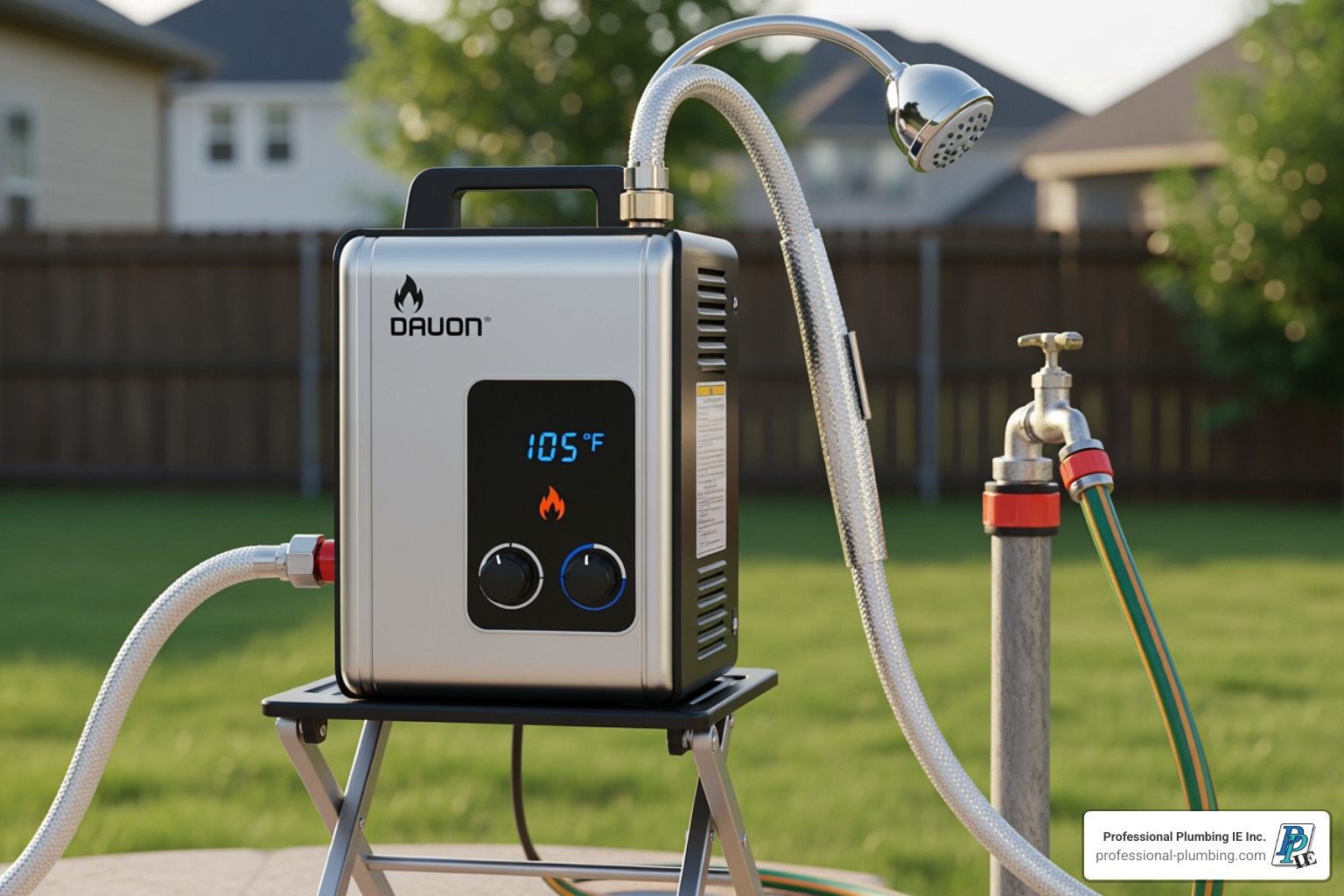
- Gallons Per Minute (GPM): For tankless units, GPM indicates the flow rate of hot water the unit can deliver. A typical shower uses about 2 gallons per minute. If you need to run a shower and a sink simultaneously, you’d need a higher GPM unit. Portable tankless units can range from 1.5 GPM to over 5 GPM. The higher the GPM, the more hot water you can get at once.
- Temperature Rise: This refers to how much the unit can increase the water temperature from its incoming cold state to your desired hot water temperature. For example, if your incoming water is 50°F and you want 120°F, you need a 70°F temperature rise. The colder the incoming water (common in winter months in the Inland Empire), the harder a unit has to work to achieve your desired temperature, which can reduce its effective GPM. The Eccotemp L10/L10nr, for instance, can provide a 96°F temperature rise at 1 GPM, but only a 25°F rise at 2.5 GPM.
- British Thermal Units (BTU): For gas-fired units, BTU measures the heating power. Higher BTU ratings mean more heating capacity and generally higher GPM at a given temperature rise. Portable propane tankless units can range from 20,000 BTU to over 75,000 BTU.
- Power Source (Gas vs. Electric): Gas-fired (propane) units generally offer higher GPM and BTU, making them suitable for multiple fixtures or colder climates, but they require outdoor ventilation. Electric units are easier to install (just plug in) and can be used indoors, but typically have lower GPM and are better for single, low-flow fixtures.
- Sizing a New Water Heater: While this guide focuses on permanent installations, the principles of calculating your hot water needs by considering peak usage apply directly to temporary solutions.
- Peak Hour Demand: Even for temporary use, consider when you’ll need the most hot water in a short period. If you anticipate multiple showers, a higher GPM unit or a small tanked unit might be necessary to avoid running out.
Understanding Costs: Purchase vs. Rental
When considering a temporary water heater, you have two main options: purchasing one or, in some cases, renting one.
- Upfront Purchase Cost: Portable tankless water heaters can range from $100 for basic immersion heaters to $500-$800 for robust propane tankless units. Point-of-use electric heaters typically fall in the $150-$400 range. The cost depends on GPM, BTU, features, and brand.
- Rental Fees: For construction sites or large events, some specialized companies or even local plumbing services might offer rental options for larger temporary water heating systems. For temporary water service from a utility, such as connecting to a fire hydrant, there are specific meter rental fees. The initial charge typically covers installation, removal, and the first 30 days of meter rental. After that, a monthly rate applies.
- Installation & Removal Charges: If you’re renting a larger system or arranging for utility-provided temporary water, there will be charges for installation and removal of the equipment. For smaller portable units, DIY installation is usually straightforward.
- Usage Costs (Propane/Electricity): Don’t forget the running costs. Propane tanks need refilling, and electric units consume electricity. Factor in these energy costs based on your anticipated usage.
- Refundable Deposits: For temporary utility water service, a refundable deposit may be required, especially if you are not an approved credit customer.
Installation, Safety, and Maintenance Essentials
Proper setup and care are critical for the safe and effective use of any temporary water heater. This is especially true for gas-powered units used outdoors or any temporary setup in unique housing, like a manufactured home in Norco.
Safe Installation and Operation of a Temporary Water Heater
Safety is paramount, especially when dealing with gas and electricity. Our team at Professional Plumbing Inc. always prioritizes safety in all our installations, from hot water heater repair to full system replacements. For temporary units, here’s what you need to know:
- Ventilation Requirements: This is the most critical safety point for propane-fired temporary water heaters. They must be used outdoors only in a well-ventilated area. Never use them in enclosed spaces like campers, tents, homes, or garages due to the risk of carbon monoxide poisoning. Carbon monoxide is an odorless, colorless gas that can be fatal.
- Outdoor Use Only (for Propane): Portable propane tankless water heaters like the Eccotemp L10/L10nr are explicitly designed and certified for outdoor use only. They are not to be permanently installed or used indoors.
- Carbon Monoxide Risks: As mentioned, propane combustion produces carbon monoxide. Ensure there’s ample airflow. If you suspect a gas leak (often indicated by an odorant added to propane, though “odorant fade” can occur), do not attempt to find the cause or light the unit. Shut off the fuel supply, leave the area, and allow gas to dissipate.
- Clearances from Combustibles: Install your temporary water heater in a fire-retardant area, away from flammable materials. Manufacturers specify minimum clearances, for example, 4 feet to the left and right sides and 6.75 feet to the front of the unit for some models. Keep the area clear of gasoline and other flammable liquids.
- Level Ground: Always place the unit on a stable, level surface to ensure proper operation and prevent tipping.
- A guide to water heater repair and safety: While focused on permanent units, many safety principles regarding water temperature, gas lines, and electrical connections apply to temporary setups as well.
Maintenance and Regulatory Considerations
Even though they’re temporary, these units need care and adherence to rules.
- Draining to Prevent Freezing: If you’re using a portable unit in colder temperatures in Jurupa Valley or Eastvale, it is crucial to drain all water from the unit after each use if temperatures are at or below freezing (32°F/0°C). Freezing water can cause significant internal damage to the heat exchanger, voiding your warranty.
- Cleaning Water Screens: Many units have a small water screen at the inlet to prevent debris from entering. Clean this monthly or as needed to maintain optimal water flow and performance.
- Descaling for Hard Water: The Inland Empire is known for its hard water. Mineral buildup can reduce efficiency and lifespan. For portable tankless units, flushing the unit every 6 months with a descaler can help prevent this.
- Code considerations for manufactured homes: If you’re considering a temporary water heater for a manufactured home in Norco, be aware of specific regulations. Tankless water heaters require specific HUD approval via an Alternative Construction (AC) letter to be used in manufactured homes. These requests must address various safety and construction standards, including temperature and pressure relief valves, testing certifications, energy efficiency, and drip collection pans. While a temporary setup might bypass some permanent installation codes, understanding these regulations is important for any potential long-term or semi-permanent use.
- Local Code Compliance: Always check local plumbing and gas codes, even for temporary installations. While portable units are often designed for ease of use, any connections to existing plumbing or gas lines should adhere to local regulations to ensure safety and prevent issues.
Frequently Asked Questions about Temporary Water Heaters
How much hot water can a portable unit provide?
A unit’s capacity is measured in Gallons Per Minute (GPM) and the temperature rise it can achieve. A typical portable propane heater might provide 1.5–2.5 GPM, enough for a single shower, while a small electric unit is best for a handwashing sink. For example, a unit might deliver a 96°F temperature rise at 1 GPM, but only a 32°F rise at 2 GPM. This means if your incoming water is very cold, your effective GPM for a hot shower will be lower.
Can I install a temporary water heater indoors?
Only electric-powered, vent-free models are safe for indoor use. Propane-fired portable water heaters produce carbon monoxide and MUST be used outdoors in a well-ventilated area to prevent serious injury or death. This is a critical safety warning from manufacturers like Eccotemp. Using a gas-fired unit indoors can lead to fatal carbon monoxide poisoning.
How do I get temporary water for a construction site?
You’ll need to contact your local utility, such as Riverside Public Utilities, to request temporary water service. This often involves setting up a metered connection to a fire hydrant and requires specific information like the exact location of the fire hydrant, desired installation and removal dates, the purpose of water use, and contact details. For company representation, you’ll also need a Letter of Authorization, corporate telephone number, corporate ID number, and Federal Tax ID number.
Need Help with Your Water Heater in the Inland Empire?
Whether you’re facing an unexpected breakdown or planning a project, having reliable hot water is essential. Understanding your options for a temporary water heater can save you from major disruption. For permanent solutions, from emergency repairs to a full water heater replacement in Riverside, it’s best to trust a professional. The experienced, family-owned team at Professional Plumbing Inc. has been serving the Riverside and Corona communities for nearly 40 years, ensuring your plumbing is done right. For expert advice and guaranteed service, contact us today.
Contact us for your water heater needs – Professional Plumbing Inc.; Family-Owned; Guaranteed Service