Gas Pipeline: Your Vital 3 Million Mile Energy Link!
Gas Pipelines in Riverside, Corona, Eastvale & Norco: Your Invisible Energy Highway
Gas pipelines power everyday life in Riverside, Corona, Eastvale, and Norco. From heating homes near California Baptist University to fueling kitchens in Eastvale’s Silverlakes area and keeping Corona’s Downtown businesses running, natural gas quietly works behind the scenes.
Across the U.S., over 3 million miles of gas pipelines transport approximately 29.2 trillion cubic feet of natural gas annually to about 78.3 million consumers. This network consists of four main types:
- Gathering pipelines – Move raw gas from wellheads to processing
- Feeder pipelines – Transport processed gas to transmission lines
- Transmission pipelines – High-pressure, long-distance transport
- Distribution pipelines – Deliver gas to your neighborhood
For homeowners in Riverside, Corona, Eastvale, and Norco, natural gas travels through this network before reaching your property. Locally, SoCalGas manages distribution lines under familiar streets like Magnolia Avenue in Riverside, Hamner Avenue in Norco, Limonite Avenue in Eastvale, and Ontario Avenue in Corona.
The gas journey starts at a wellhead, flows through processing plants, crosses the country via transmission lines, and reaches neighborhoods like La Sierra, Sierra Del Oro, Eastvale Gateway, or Old Town Norco. By then, pressure has been reduced and safety systems protect local families.
Understanding this system is essential for your safety. From compressor stations maintaining pressure every 50-100 miles to odorant added at city gates so you can detect leaks, every component serves a critical purpose.
I’m Chris Kirsten, with four decades serving the Inland Empire. My team has installed and repaired thousands of gas lines from older homes near Downtown Riverside to newer Eastvale developments and Norco horse properties. We’ve seen what works, what fails, and how local codes apply.
This guide covers everything about the gas pipeline network serving your community—whether you live near Norco High, Corona High, Roosevelt High in Eastvale, or Riverside City College.
Gas pipeline glossary:
From Wellhead to Your Riverside or Corona Water Heater: The Journey of Natural Gas
Have you ever wondered how the natural gas that warms your home in La Sierra or cooks your dinner in Downtown Corona actually makes its way to your appliances? If you live in Riverside, Eastvale, Norco, or Corona, your gas has traveled hundreds or even thousands of miles through a carefully engineered gas pipeline system before it reaches your water heater or stove.
Gathering & Processing: The First Steps
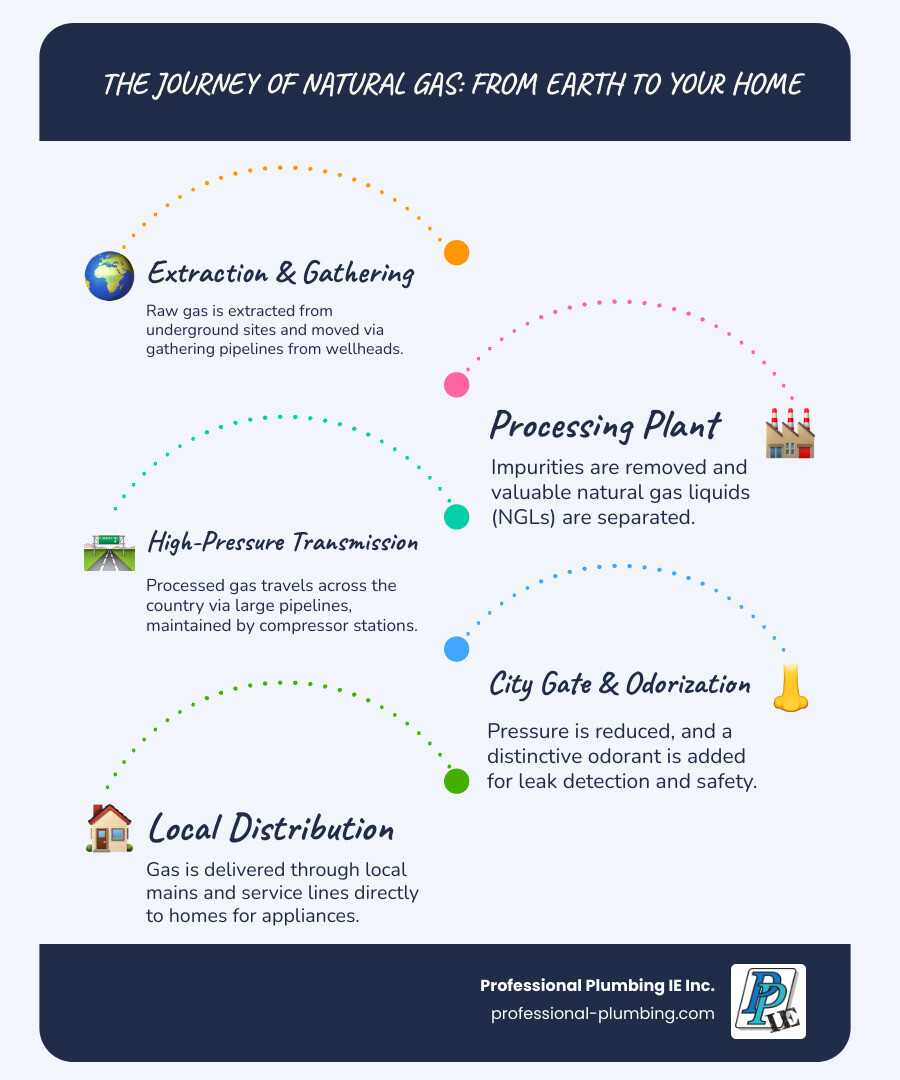
The journey of natural gas begins deep underground, extracted from geological formations. Once brought to the surface, this raw natural gas isn’t immediately ready for use. It first enters a network of gathering pipelines. These are typically small-diameter, low-pressure lines that collect the gas from multiple wellheads and transport it to larger natural gas processing plants. Think of them as the capillaries of the gas pipeline network, bringing the initial collection to a central point.
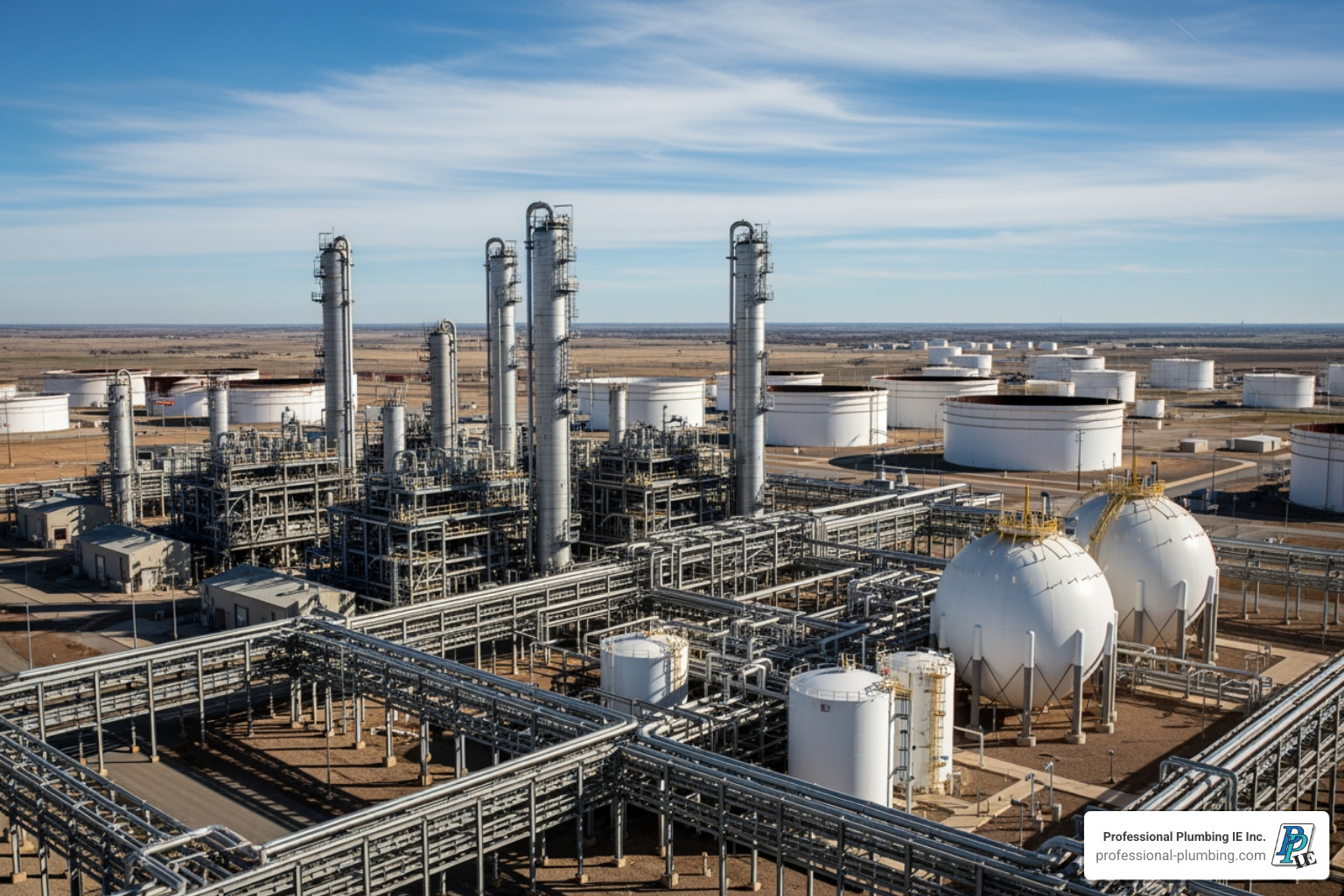
At these processing plants, the raw gas undergoes a crucial change. Impurities such as water vapor, sulfur compounds, and other non-hydrocarbon elements are carefully removed. More importantly, valuable natural gas liquids (NGLs) like propane, butane, and ethane are separated from the methane, which is the primary component of the natural gas we use. This separation ensures the gas is clean, efficient, and meets quality standards for transportation and combustion.
Transmission: The Interstate Highways
Once processed, the cleaned natural gas enters the backbone of the system: the transmission pipelines. These are the “interstate highways” of the natural gas world, characterized by their wide diameter and high-pressure operation, typically ranging from 500 to 1400 pounds of pressure per square inch. Crafted from robust carbon steel, these pipelines are designed to move vast quantities of gas across long distances, often spanning multiple states.
To maintain the high pressure necessary for efficient flow over hundreds or even thousands of miles, powerful compressor stations are strategically placed along the transmission lines. These stations, generally built every 50 to 100 miles, give the gas a “push,” compensating for pressure drops due to friction and elevation changes. These stations operate 24/7, ensuring a steady flow.
In the U.S., the transmission network is a highly integrated grid, capable of moving natural gas to and from nearly any location in the lower 48 states. This network includes over 305,000 miles of interstate and intrastate transmission pipelines. Interstate pipelines cross state lines and are typically regulated by federal authorities, while intrastate lines operate within a single state.
For residents in the Inland Empire, those long-distance transmission lines feed the local systems that serve communities around Riverside Plaza, Corona’s Green River corridor, Eastvale’s retail hub at Hamner & Limonite, and Norco’s Sixth Street business district. They’re the reason homes, restaurants, and small businesses in these areas have reliable gas service even during cold snaps and peak usage.
Distribution: The Final Mile to Your Home in Riverside, Corona, Eastvale & Norco
After its long journey through the transmission network, the natural gas arrives at the doorstep of our communities. Here, it transitions into the distribution network, the final stage before reaching your home or business. This network is managed by local distribution companies (LDCs) like SoCalGas, which serve homes and businesses in areas such as Jurupa Valley, Norco, Mira Loma, Eastvale, Riverside, and Corona.
The point where the high-pressure transmission pipeline connects to the lower-pressure distribution system is known as the city gate. At this crucial juncture, the gas pressure is significantly reduced to safe levels suitable for local delivery.
Perhaps the most important step at the city gate, from a safety perspective, is odorization. Natural gas is naturally colorless and odorless, making leaks incredibly difficult to detect. So, a harmless chemical called Mercaptan is injected into the gas, giving it that distinctive “rotten egg” smell. This ensures that if a leak occurs in your home or neighborhood—whether it’s near Norco High School, close to Eastvale’s Harada Heritage Park, or in a Riverside neighborhood off Arlington Avenue—you’ll be able to smell it and take appropriate action.
From the city gate, the gas flows through increasingly smaller mains and service lines that crisscross our neighborhoods, eventually connecting directly to your property. These are the pipes that bring natural gas directly to your water heater, furnace, stove, or outdoor grill—whether you’re in a newer Eastvale subdivision or an older Corona neighborhood with mature trees and established landscaping.
If you’re curious where those local gas lines run near your street or want to understand how your home connects to the bigger system, we’ve put together a helpful guide: More info about Natural Gas Lines in My Area. It’s especially useful before projects like installing a pool in Eastvale, replacing fencing on a Norco horse property, or planning landscaping at a Riverside or Corona home.
The North American Gas Pipeline Network: A Brief History
The gas pipeline network we rely on today resulted from decades of innovation and evolving energy landscapes.
The Impact of Unconventional Gas
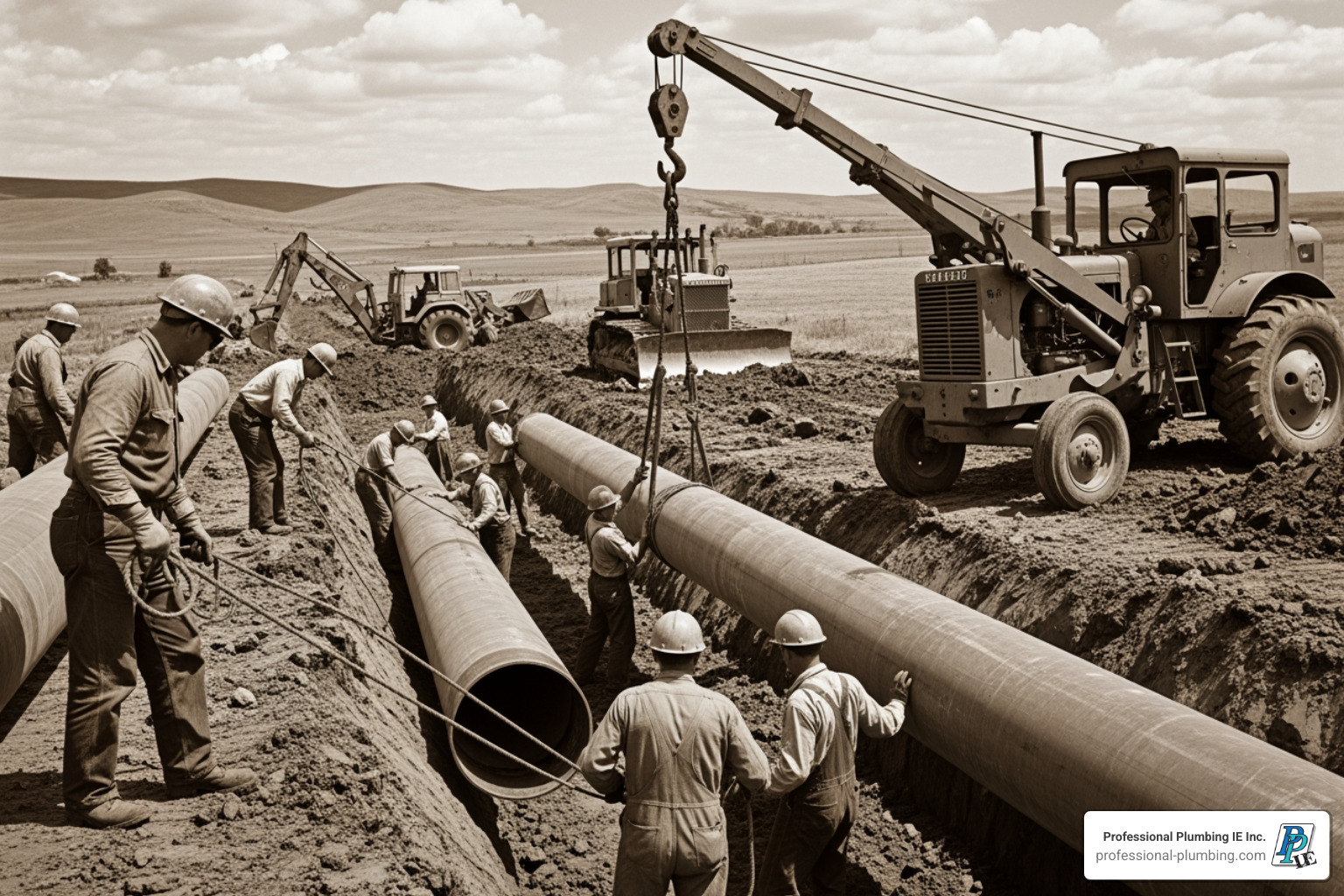
The network saw major expansion after World War II when consumer demand doubled, leading to about half of the existing U.S. mainline network being installed in the 1950s and 1960s. This growth served new housing and commercial developments, including the booming Inland Empire.
The most transformative shift came with the shale gas revolution in the early 21st century. Advances in horizontal drilling and hydraulic fracturing opened vast reserves from shale formations, dramatically increasing U.S. natural gas production.
In Canada, tight gas production accounted for roughly 66% of total gas production in 2020. This surge fundamentally altered market dynamics and necessitated significant adjustments to existing gas pipeline infrastructure. Former export points were even reversed to allow imports from the now gas-rich U.S.
This unconventional gas growth profoundly impacted pipeline capacity and led to numerous construction projects to move gas from new production hubs to markets.
How Market Dynamics Influence the System
Natural gas availability and gas pipeline capacity are influenced by complex market dynamics. Supply, demand, weather patterns, and global events cause price fluctuations. These variations, alongside transportation costs, create “basis differentials” between pricing hubs like Henry Hub in the U.S. or Alberta-NIT in Canada.
When pipeline capacity is constrained, it creates “bottlenecks”—like a multi-lane highway narrowing to a single lane. This can lead to oversupply in producing regions, driving down local prices sometimes to negative values, while gas in demand centers remains expensive. This underscores the critical role of efficient pipeline infrastructure in balancing supply and demand, including delivering affordable energy to Corona and Norco homes and businesses.
Keeping Gas Pipelines Safe in Riverside, Corona, Eastvale & Norco
The safety of gas pipelines is paramount in growing communities like Riverside, Corona, Eastvale, and Norco, where new construction and backyard projects are common. Stringent regulations and continuous maintenance protect families, businesses, and the environment.
As a family-owned business in the Inland Empire, we regularly work in neighborhoods around UCR, La Sierra, Dos Lagos, Eastvale Gateway, and Norco’s equestrian areas, seeing first-hand how local codes and safety practices apply.
Who’s in Charge? Pipeline Regulation in California
Regulation of gas pipelines involves multiple authorities. The Federal Energy Regulatory Commission (FERC) and Pipeline and Hazardous Materials Safety Administration (PHMSA) are primary federal regulators. FERC oversees interstate transmission pipelines while PHMSA focuses on safety standards.
In California, the California Public Utilities Commission (CPUC) regulates intrastate pipelines and SoCalGas, which serves Riverside, Corona, Eastvale, Norco, and Jurupa Valley.
Local building departments—Riverside’s Building & Safety, Corona’s Community Development, and Norco Building & Safety—enforce gas line requirements. When you pull permits for projects near Fairmount Park or in Eastvale, these offices apply California code.
Local codes dictate gas line installations and repairs, ensuring every connection meets safety standards. We’re well-versed in California’s strict gas line codes and ensure compliance with all requirements.
Essential Safety Measures for Every Gas Pipeline
Ensuring gas pipeline integrity involves proactive measures:
- Corrosion Protection: Cathodic protection uses electrical currents to prevent rust, while pipeline coatings create barriers between steel and soil.
- Leak Detection: Beyond Mercaptan’s olfactory warning, SCADA systems monitor flow rates and pressures continuously. Regular right-of-way patrols and leakage surveys are conducted.
- Integrity Management: This approach identifies and validates pipeline integrity, especially in High Consequence Areas near Galleria at Tyler, Corona’s Main Street, or Eastvale shopping centers.
- Excess Flow Valves (EFVs): These automatically shut off gas flow if service lines break—important for properties with long driveways in Norco and rural Riverside County.
If you suspect a gas leak, we’ve created guides: What to Do If You Suspect a Gas Leak and More info about Gas Leak Riverside services.
Advanced Engineering: Looping and Crossovers
Pipeline looping adds parallel segments alongside existing pipelines—like adding highway lanes. This increases capacity and alleviates bottlenecks, ensuring gas flows to Corona, Eastvale, Riverside and Norco without interruption.
Crossover assemblies connect looped segments to main pipelines and enable rerouting during maintenance. Like detours on the 91 or 15 freeways, they keep gas flowing even when sections need repair.
The Future of Gas Pipelines: Trends and Innovations
The gas pipeline industry is not static; it’s constantly evolving to meet new energy demands, improve safety, and adapt to a changing environmental landscape. We’re seeing exciting trends and innovations that will shape how natural gas, and even other gases, are transported in the future.
Supporting a Greener Future
One of the most significant trends is the increasing role of pipelines in transporting Renewable Natural Gas (RNG), also known as biomethane. RNG is produced from organic waste materials like landfills, wastewater treatment plants, and agricultural operations. It’s chemically identical to conventional natural gas, meaning it can be transported through the existing gas pipeline infrastructure without modification. This is a game-changer for reducing carbon footprints, as it turns waste into a valuable energy source.
The Trans Québec & Maritimes Pipeline (TQM) system, for example, is already interconnected to two renewable natural gas receipts, demonstrating how existing infrastructure can support a greener energy mix. The TQM pipeline, which is 649 km (403 miles) long, supplies natural gas to residential, commercial, and industrial customers in Québec and downstream into the northeastern U.S. and Atlantic Canada. It’s regulated by the Canada Energy Regulator (CER). You can find more commercial information about it at TQM Pipeline.
Another area of innovation is hydrogen blending. Researchers are exploring the possibility of blending hydrogen with natural gas and transporting it through existing pipelines. While promising for decarbonization, this also presents engineering challenges, such as hydrogen embrittlement, which can weaken steel pipes over time. This requires careful material selection and monitoring.
Technological Advancements in Safety
Safety remains a top priority, and technology is continuously improving our ability to manage and protect gas pipelines.
- Smart Pig Inspections: “Smart pigs” are advanced robotic devices that travel inside pipelines, using sophisticated sensors to detect anomalies like corrosion, cracks, or dents without disrupting gas flow. These inspections provide crucial data for proactive maintenance and repair.
- Advanced Sensor Technology: New sensors, often fiber-optic, are being developed to detect even minute leaks, ground movement, or unauthorized excavation attempts in real-time, providing immediate alerts to operators.
- Computational Pipeline Monitoring (CPM): This software uses complex algorithms to continuously analyze operational data (pressure, flow, temperature) and hydraulic behavior. CPM systems can detect unusual patterns that might indicate a leak or other operational issue, often before it becomes a significant problem.
These technological advancements, combined with rigorous regulatory oversight, mean that the gas pipeline network is becoming safer and more reliable than ever before.
Frequently Asked Questions about Gas Pipelines in Riverside, Corona, Eastvale & Norco
We often get questions from our customers in Riverside, Corona, Eastvale, Norco, and nearby Jurupa Valley about the gas pipelines that serve their homes. Here are some of the most common ones, answered with our local experience.
How deep are gas lines buried around my home in Eastvale or Norco?
The depth at which gas pipelines are buried depends on their type and location:
- Transmission pipelines: Federal regulations require these major lines to be buried at least 30 inches below the surface in rural areas and 36 inches in more populated areas. At road or railroad crossings, they must be at least 36 inches deep, and at navigable water crossings, 48 inches.
- Distribution mains: These larger pipes in your neighborhood are typically buried at least 24 inches deep, though there can be exceptions.
- Service lines: The smaller lines connecting from the main to your property are usually buried at least 12 inches deep on private property and 18 inches along roads or streets.
In practical terms, this means the gas running under streets like Hamner Avenue (Norco/Eastvale), Limonite Avenue (Eastvale/Jurupa Valley), Magnolia Avenue (Riverside), or Ontario Avenue (Corona) is safely buried—but depth can change over time due to ground settling, erosion, past grading, or old construction work.
That’s why we always emphasize the importance of calling 811 (DigAlert) before any digging project, no matter how small, in areas like Eastvale, Norco, Riverside, or Corona. Whether you’re installing horse fencing in Norco, a new mailbox in Corona, a tree in your Riverside front yard, or a backyard swing set in Eastvale, 811 is free, easy, and helps prevent accidental damage to underground utilities.
For more information on safely locating your gas lines and shutting them off at the meter—a skill every homeowner near local schools, parks, or high-density neighborhoods should know—check out our guide: More info about How to Locate and Shut Off Your Natural Gas Line.
What are the different types of natural gas pipelines?
As we discussed earlier, the natural gas network is a layered system, each with a specific function:
- Gathering pipelines: These collect raw natural gas directly from the wellheads.
- Feeder pipelines: These transport processed gas from treatment facilities to the larger transmission lines.
- Transmission pipelines: These are the high-pressure, long-distance lines that move gas across states and regions.
- Distribution pipelines: These are the local networks (mains and service lines) that deliver gas directly to homes and businesses.
In Riverside County communities, you mostly interact with the distribution side of the system—that’s the network that brings gas into homes near La Sierra University, businesses around Dos Lagos in Corona, neighborhoods near Eastvale Gateway, and horse properties throughout Norco.
Each type plays a vital role in ensuring that natural gas gets from its source to your appliances safely and reliably.
Can I perform repairs on my own gas line?
No. Working on a gas pipeline or any gas appliance connection is extremely dangerous and should never be attempted by an untrained individual.
Natural gas is highly flammable, and improper repairs can lead to leaks, explosions, fires, serious injury, or even fatalities. We’ve seen DIY attempts in older Riverside and Corona homes where unpermitted work led to slow leaks behind walls or under raised foundations—issues that could have been catastrophic if not caught in time.
In California, state and local codes in cities like Riverside, Corona, Eastvale, Norco, and Jurupa Valley require that all gas line installations, repairs, and alterations be performed by licensed and certified professionals. These professionals have the specialized training, tools, and expertise to safely handle natural gas, diagnose issues, make code-compliant repairs, and perform necessary safety checks like pressure testing.
Attempting DIY gas work can:
- Void your home insurance
- Lead to code violations and fines if discovered during inspections or a home sale
- Put your family, neighbors, and property at serious risk
When it comes to gas lines—whether you’re adding a line for a backyard BBQ in Norco, upgrading a stove in Corona, or relocating a water heater in Riverside or Eastvale—always call a professional. For insights into what to expect when hiring professionals for gas line work, including typical pricing in the Inland Empire, see our article on More info about Gas Line Repair Cost.
Your Trusted Local Partner for Gas Line Safety in Riverside, Corona, Eastvale & Norco
The vast and intricate gas pipeline network is a marvel of modern engineering—an invisible energy highway that seamlessly delivers the natural gas essential to our daily lives. From the distant wellheads to the pipes beneath your street in Eastvale, Norco, Riverside, or Corona, every segment is designed, operated, and maintained with precision and an unwavering commitment to safety.
For residents in Riverside (from the Wood Streets to Orangecrest), Corona (from Sierra Del Oro to South Corona), Eastvale’s newer master-planned communities, and Norco’s unique horse properties and ranch homes, understanding your home’s connection to this network is key to ensuring your safety and peace of mind. While the major pipelines are a complex system, your home’s gas lines are your direct link, and they require the same level of care and expertise.
At Professional Plumbing IE Inc., we’ve been serving the Inland Empire for nearly 40 years. We’ve worked on gas lines in:
- Older Riverside neighborhoods with raised foundations near Riverside City College and Downtown
- Newer Corona developments around Dos Lagos and The Crossings
- Eastvale tracts near Harada Heritage Park and Eastvale Community Center
- Norco ranch-style homes close to Ingalls Park and along Sixth Street
When you need expert service for your home’s gas lines—from a new appliance hookup to safety inspections or leak repairs—our highly trained and certified team is ready to help. We prioritize your safety and satisfaction, providing professional, guaranteed quality service at affordable rates and in full compliance with California code and local city requirements.
If you’re in Riverside, Corona, Eastvale, or Norco and have questions about your gas piping, smell gas, or are planning a remodel or new gas appliance, we’re here to help you make safe, informed decisions.
For all your natural gas service needs, trust the local experts who work in your neighborhoods every day: More info about Natural Gas services.